The Different Types of Cloud Computing
Key Takeaways
Cloud computing isn't one-size-fits-all; it operates on a spectrum of responsibility split between you and AWS. Think of it like building with LEGO bricks: IaaS gives you the raw, unconfigured blocks (EC2); PaaS gives you a pre-assembled frame where you just drop in your code (Elastic Beanstalk); and SaaS gives you a fully finished, ready-to-use toy (Amazon Rekognition or Zoom).
Financially, AWS boils cloud billing down to three core drivers: Compute (pay per second/hour), Storage (pay per GB), and Data Transfer Out (inbound is always free).
Main Discussion
The Shared Responsibility Gradient: Service Model Breakdown
Understanding cloud service models means understanding who manages what in the technology stack.
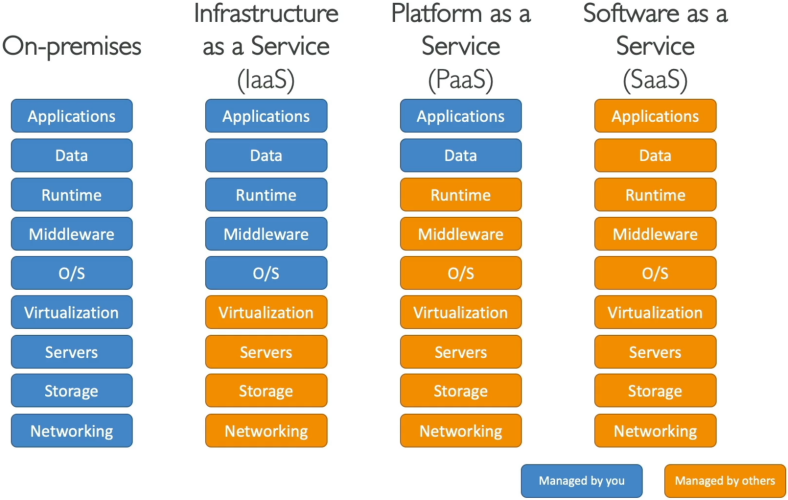
- Infrastructure as a Service (IaaS): Provides raw networking, virtual machines, and storage. Gives maximum flexibility and architectural control.
- AWS Example: Amazon EC2
- Industry Examples: Google Cloud Compute Engine, Microsoft Azure VMs, Linode, DigitalOcean
- Platform as a Service (PaaS): Abstracts away OS patching, hardware provisioning, and runtime management so developers can focus solely on application deployment and code.
- AWS Example: AWS Elastic Beanstalk
- Industry Examples: Heroku, Google App Engine
- Software as a Service (SaaS): Fully managed, end-user applications delivered over the internet. You configure settings and consume capabilities without touching underlying code or infrastructure.
- AWS Example: Amazon Rekognition (pre-trained AI vision API)
- Industry Examples: Gmail, Zoom, Dropbox
The Operational Responsibility Equation
We can express the management burden on your internal IT operations team as a function of the cloud model chosen:
Deciphering the AWS Financial Engine: The 3 Pricing Pillars
AWS eliminates upfront hardware costs by driving all consumption through a utility-style pay-as-you-go model.
- Compute: Billed based on execution duration and instance size (e.g., clock hours or seconds an EC2 instance or AI inference task runs).
- Storage: Billed based on the total volume of data (in Gigabytes/Terabytes) stored persistently in services like Amazon S3 or EBS.
- Networking (Data Transfer):
- Inbound Data Transfer (Data IN): 100% Free across all AWS services.
- Outbound Data Transfer (Data OUT): Aggregated across services and charged on a per-GB basis as data leaves the AWS Cloud.
Exam Guide
Exam Tips
- Identify Service Models for AI Services: Pay close attention to how AWS AI services are categorized on the exam:
- Amazon EC2 / EBS: IaaS (you manage the virtual machine and OS).
- AWS Elastic Beanstalk / SageMaker Managed Endpoints: PaaS (managed runtime environment for applications/models).
- Amazon Rekognition / Amazon Polly / Amazon Transcribe: SaaS (turnkey, pre-trained AI APIs where you pass data and get instant results without managing models or servers).
- Data Transfer In vs. Out: A classic trap question involves egress fees. Remember: Data coming into AWS is always free. You only pay when data leaves the AWS region or cloud environment to the internet.
Practice Test
Question 1
A developer wants to integrate image classification capabilities into a web application. They prefer to send images to an existing pre-trained AWS API and receive JSON label predictions without managing training jobs, virtual machines, or operating system patches. Which cloud service model and AWS service best fit this requirement?
- A. IaaS using Amazon EC2
- B. PaaS using AWS Elastic Beanstalk
- C. SaaS using Amazon Rekognition
- D. Hybrid Cloud using AWS Outposts
Correct Answer
- C. SaaS using Amazon Rekognition
- Explanation: Amazon Rekognition provides a ready-to-use, pre-trained machine learning API, making it a Software as a Service (SaaS) capability where AWS manages all models, servers, runtimes, and underlying infrastructure.
Question 2
A cloud practitioner is reviewing a monthly AWS invoice and notices a line item for network charges. Which network traffic pattern incur a fee under standard AWS billing rules?
- A. Uploading 500 GB of training datasets from an on-premises workstation into an Amazon S3 bucket
- B. Inbound data transfer from the internet into an Amazon EC2 instance
- C. Transferring data out from an Amazon S3 bucket to an external internet destination
- D. Data ingress coming through a public endpoint into an AI processing pipeline
Correct Answer
- C. Transferring data out from an Amazon S3 bucket to an external internet destination
- Explanation: Under the AWS pricing fundamentals, Data Transfer IN is always free. AWS charges network egress fees specifically when data is transferred OUT of the AWS cloud to the internet or another external region.