FM Evaluation - Hands On
Key Takeaways
Amazon Bedrock provides a native, structured evaluation engine under Inference and Assessment > Evaluations to systematically benchmark model quality, safety, and operational fit.
Automatic evaluation runs either Programmatically (using deterministic mathematical/algorithmic scoring) or via Model-as-a-Judge (using an advanced reasoning model like Claude 3.5 Sonnet to score outputs). For subjective tasks, Human Evaluation allows comparing up to two models side-by-side using either your own private workforce or an AWS-managed reviewer team.
Hands-On Workflow: Configuring Bedrock Model Evaluations
- Navigate to Model Evaluations:
- Open the Amazon Bedrock Console.
- In the left-hand navigation pane, locate the Assess section.
- Click on Evaluations to open the evaluation dashboard.
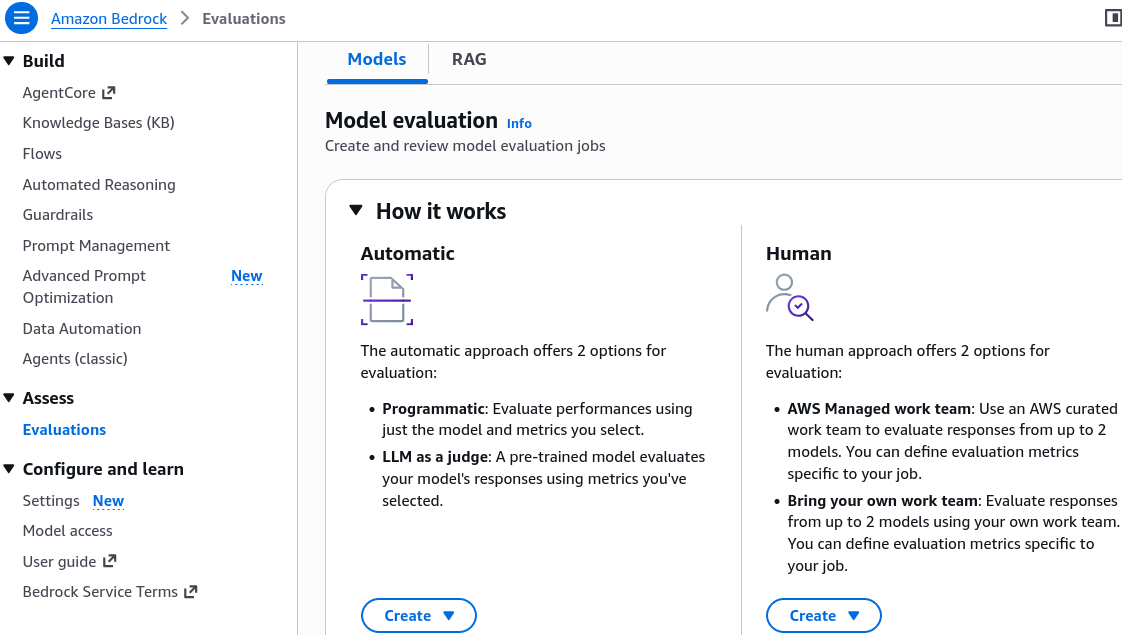
- Configure an Automatic Programmatic Evaluation:
- Click Create and select Automatic: Programmatic.
- Model Selection: Choose the Foundation Model to evaluate (e.g., Amazon Nova or Meta Llama).
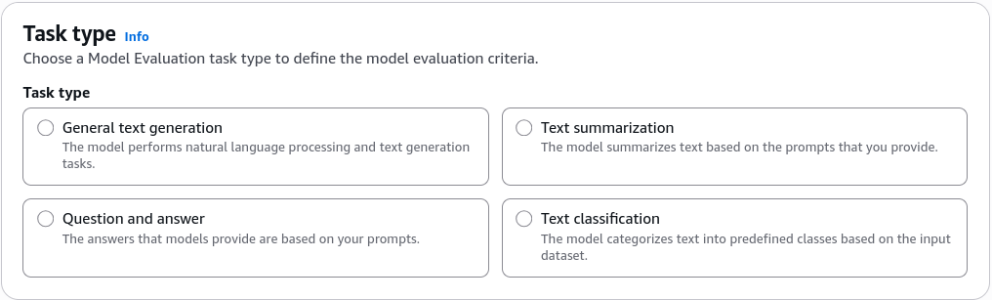
- Task Type: Select the target task domain (e.g., General text generation, Text summarization, Question and Answer, or Text classification).
- Predefined Metrics: Toggle desired algorithmic metrics such as Toxicity, Accuracy, and Robustness.
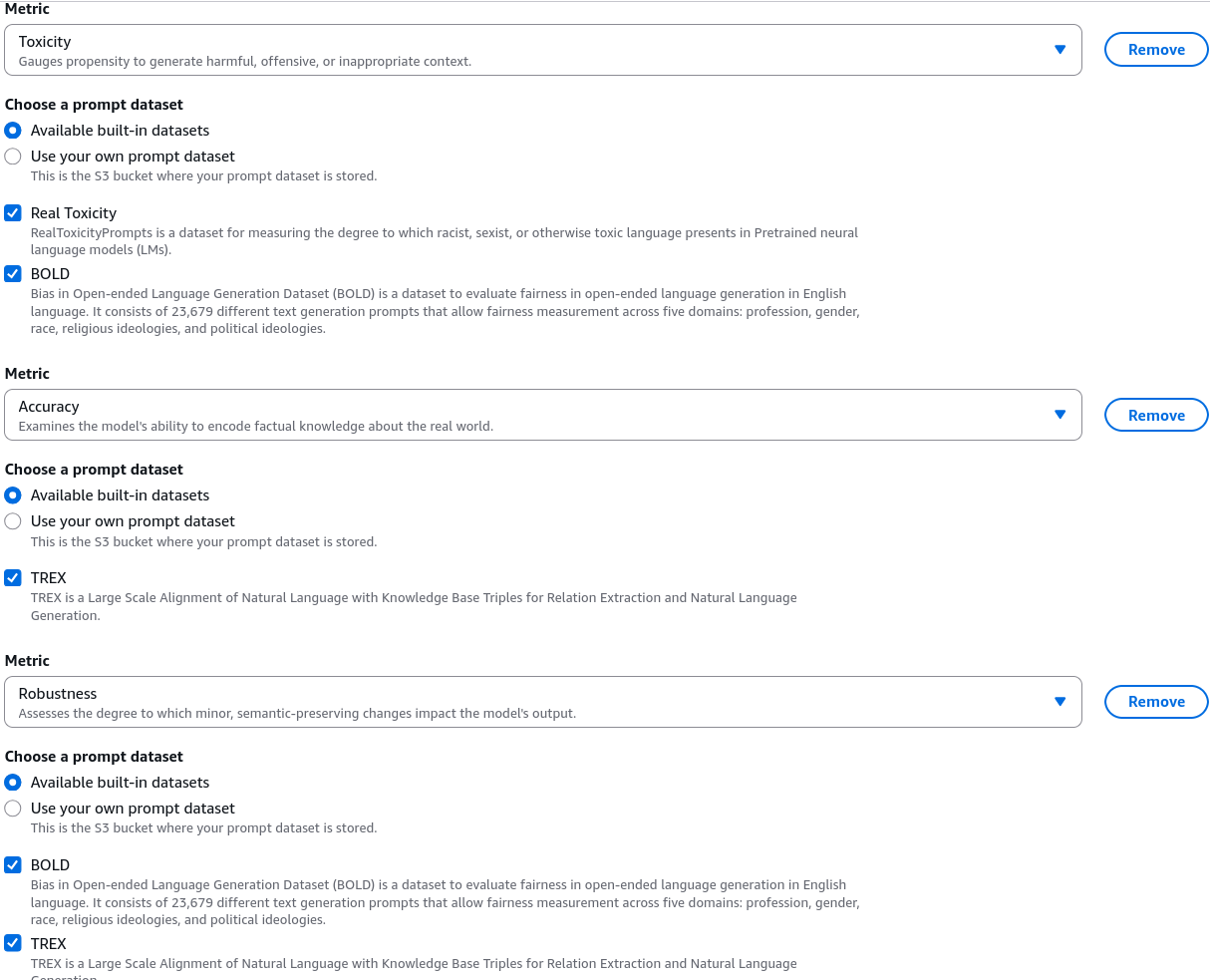
- Datasets: Select either the AWS built-in curated prompt datasets or provide your own custom dataset hosted in Amazon S3.
- Permissions & Output: Designate an Amazon S3 URI to store evaluation output cards and reports, and assign the appropriate IAM service role.
- Set Up a Model-as-a-Judge Evaluation:
- Click Create and select Automatic: Model as a judge (LLM-as-a-Judge):
- Evaluator Model: Select a high-reasoning judge model (e.g., Anthropic Claude 3.5 Sonnet).
- Inference Source:
- Choose a Bedrock-hosted model (e.g., Amazon Nova Pro), OR
- Choose Bring Your Own Inference (BYOI) to score pre-generated inference responses from models hosted outside of Amazon Bedrock.
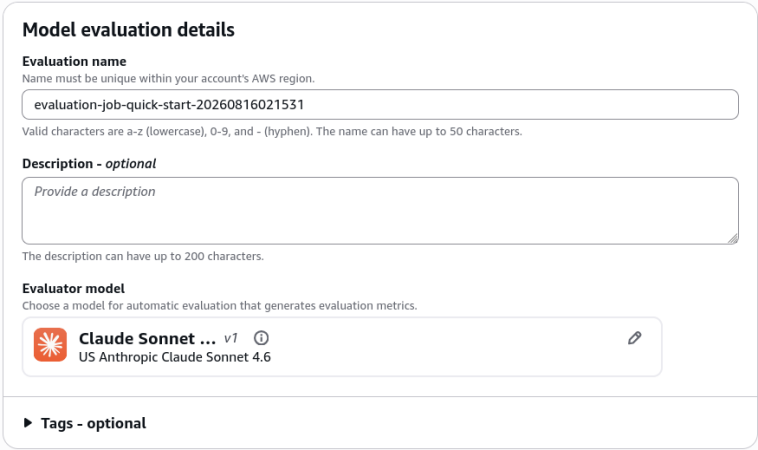
Evaluator Model 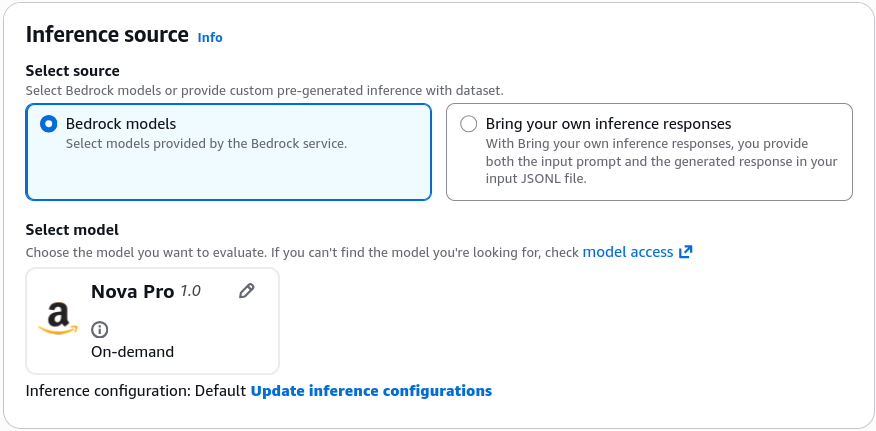
Inference Model
- Evaluator Metrics: Select nuanced quality and alignment dimensions such as Helpfulness, Faithfulness, Correctness, and Relevance.
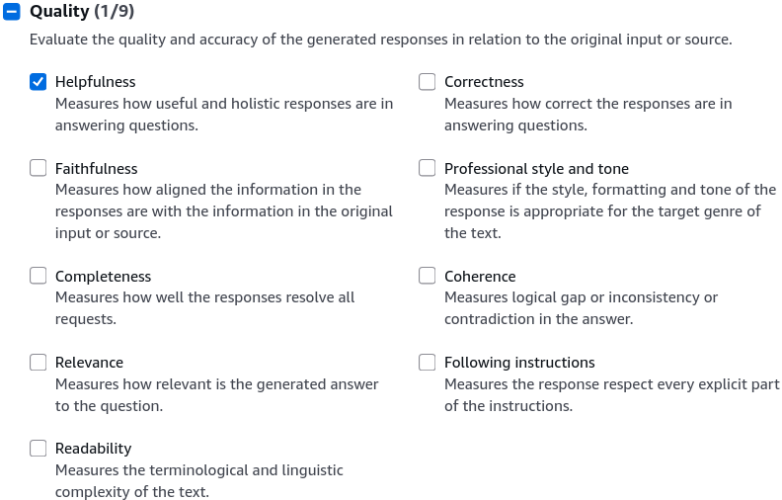
Quality Metrics 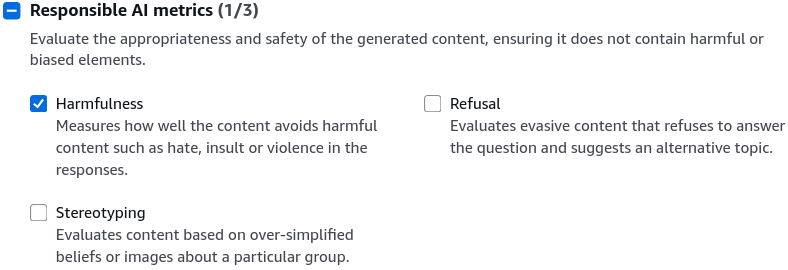
Responsible AI Metrics
- Configure a Human Evaluation Job:
- Click Create and select Human:
- Workforce Type:
- AWS Managed Team: AWS provisions and manages vetted external annotators.
- Bring Your Own Workforce (Private Team): Uses your organization's internal team members via Amazon SageMaker Ground Truth work teams.
- Model Comparison: Select up to two models (e.g., Amazon Nova Pro vs. Anthropic Claude 3.5 Sonnet) to present side-by-side responses to human raters.
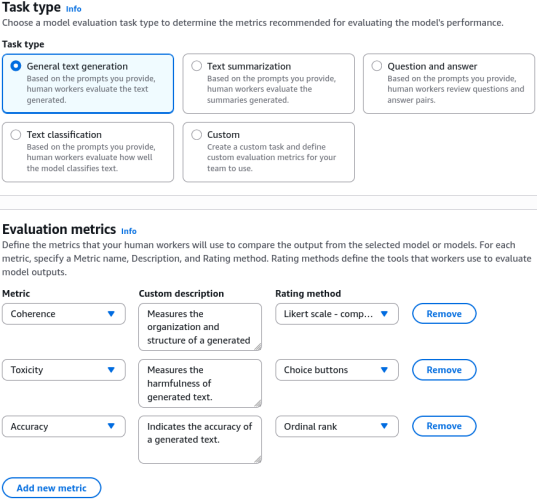
- Task & Metrics: Choose a standard task type or define a Custom Task with specific rating methods (e.g., Likert scales, Thumbs Up/Down, multi-attribute preference ranking).
- Submit the job to route evaluation batches to the designated worker portal.
Exam Guide
Exam Tips
- Evaluation Taxonomy on the Exam:
- Automatic: Programmatic: Uses deterministic algorithms on datasets; best for rapid, reproducible checks on Toxicity, Accuracy, and Robustness.
- Automatic: Model-as-a-Judge: Uses an LLM to evaluate another model's outputs; ideal for semantic quality dimensions like Helpfulness, Faithfulness, and Factuality without manual review overhead.
- Human Evaluation: Best for subjective human preferences, styling, and empathy. Can evaluate up to two models side-by-side.
- BYOI (Bring Your Own Inference): Bedrock Model Evaluation supports evaluating models hosted outside of Bedrock by uploading prompt-response pairs into Amazon S3 for evaluation by a Bedrock judge model.
- Storage & IAM: Evaluation reports, aggregated scores, and metric JSON files are always written to Amazon S3 and require an IAM role with
s3:PutObjectpermissions.
Practice Test
Question 1
A data science team wants to evaluate whether an Amazon Bedrock foundation model generates toxic or unsafe responses when tested against a predefined set of adversarial prompts. The team requires a fully automated evaluation without human reviewers or using a secondary generative model as a judge. Which evaluation method in Amazon Bedrock should they choose?
- A. Human evaluation with an AWS Managed team
- B. Automatic: Programmatic evaluation selecting Toxicity as a metric
- C. Automatic: Model-as-a-Judge selecting Claude 3.5 Sonnet
- D. Supervised Fine-Tuning with an AWS Lambda validation split
Correct Answer
- B. Automatic: Programmatic evaluation selecting Toxicity as a metric
- Explanation: Automatic Programmatic evaluation uses predefined, deterministic algorithms and datasets to compute quantitative safety and quality metrics—such as Toxicity, Robustness, and Accuracy—without requiring human annotators or a secondary judge LLM.
Question 2
An enterprise wants to compare the customer friendliness and empathetic tone of two foundation models side-by-side before releasing a customer support chatbot. The company wants its internal customer experience team to rate and rank the model responses. Which Bedrock evaluation approach fulfills these requirements?
- A. Automatic Programmatic evaluation using BLEU and ROUGE metrics
- B. Automatic Model-as-a-Judge evaluation evaluating three models simultaneously
- C. Human evaluation using "Bring your own workforce" comparing up to two models
- D. Model Distillation with an AWS Lambda custom reward script
Correct Answer
- C. Human evaluation using "Bring your own workforce" comparing up to two models
- Explanation: Human evaluation in Amazon Bedrock supports evaluating and comparing up to two models side-by-side using a private internal workforce (Bring your own workforce) or an AWS-managed team to assess subjective qualities like friendliness, tone, and empathy.