Prompt Performance Optimization
Key Takeaways
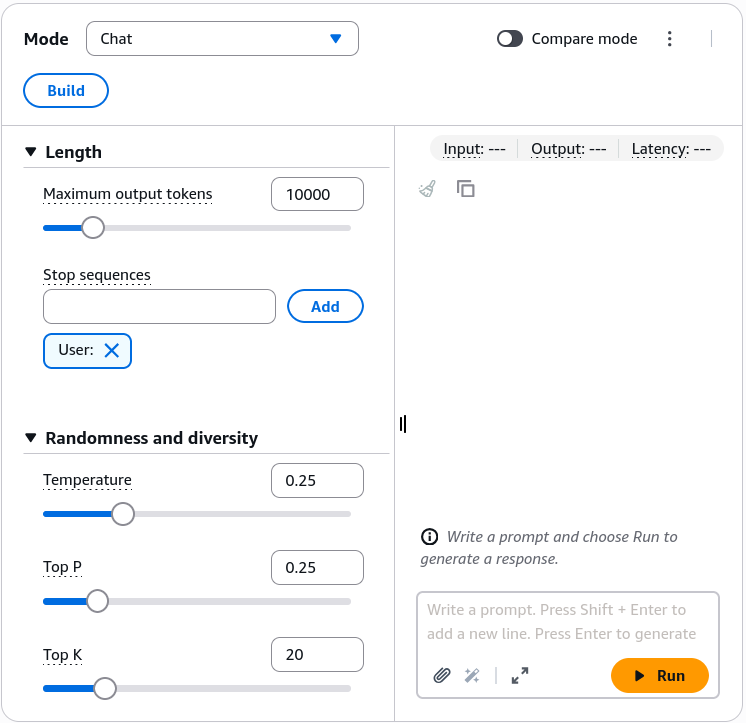
Foundation models generate completions sequentially by calculating probability distributions over candidate vocabulary tokens. You can control this token sampling process using inference decoding hyperparameters: System Prompts, Temperature, Top-P (Nucleus Sampling), Top-K, Max Generation Length, and Stop Sequences.
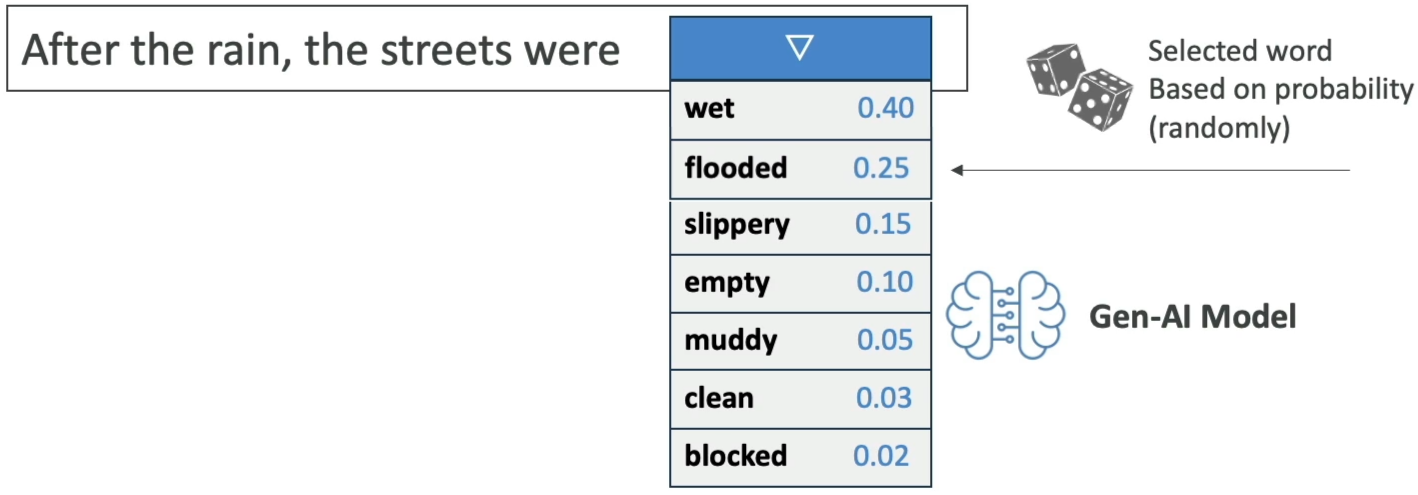
| Temperature | Top-P (Nucleus Sampling) | Top-K |
|---|---|---|
| _ Low (0.0-0.2) -> Conservative/Math _ High (0.8-1.0) -> Creative/Diverse | _ Low (0.25) -> Top 25% prob mass _ High (0.99) -> 99% broad pool | _ Low (K=10) -> Top 10 words _ High (K=500) -> Top 500 words |
Critical architectural principle: Decoding parameters (Temperature, Top-P, Top-K) do not affect inference latency or API token pricing. Latency is driven by model parameter scale, model family architecture, input prompt token size, and total output tokens generated.
Main Discussion
Inference Hyperparameters: Mechanisms & Behavior
| Parameter | Range / Type | Low Value Behavior | High Value Behavior |
|---|---|---|---|
| System Prompt | Natural language text | N/A | Sets persona, behavioral rules, tone, and domain expertise |
| Temperature | 0.0 to 1.0 (or >1.0) | Deterministic, factual, focused | Creative, diverse, exploratory, less predictable |
| Top-P (Nucleus Sampling) | 0.0 to 1.0 | Restricts pool to top probability mass | Expands candidate pool across 90%+ cumulative probability mass |
| Top-K | Integer (e.g. 1-500) | Considers only the top tokens | Considers up to candidate tokens for higher variety |
| Max Length | Integer token count | Truncates output early | Permits longer multi-turn or long-form responses |
| Stop Sequences | String / Token array (e.g. "\n\n", "User:") | N/A | Halts generation immediately upon emitting the specified sequence |
Temperature vs. Top-P vs. Top-K: The Mathematical Difference
| Parameter | Definition & Effect |
|---|---|
| 1. TEMPERATURE (Modulates Logit Curve Softness) | Softmax Logit Transformation: P(w_i) = exp(z_i / T) / Sum(exp(z_j / T)) _ T -> 0.0: Sharp spike on the highest-probability token (Greedy search). _ T -> 1.0: Flattens logits, giving lower-ranked tokens higher selection odds. |
| 2. TOP-P / NUCLEUS SAMPLING (Dynamically Adapts by Mass) | Selects the smallest subset of tokens V^(P) such that: Sum_{w in V^(P)} P(w) >= P _ Dynamically expands when predictions are uncertain (flat distribution) _ Shrinks to 1-2 tokens when the model is confident (sharp distribution) |
| 3. TOP-K SAMPLING (Static Count Cutoff) | Selects strictly the top K tokens with highest probabilities: |V^(K)| = K |
Factors Dictating Model Inference Latency
When optimizing generative AI response times, isolate true architectural bottlenecks from sampling settings:
| Latency Drivers (Direct Impact) | Non-Latency Factors (Zero Impact) |
|---|---|
| _ Foundation Model Parameter Scale _ Model Architecture (Nova Micro vs. Claude Sonnet) _ Input Prompt Token Length _ Output Generated Token Volume | _ Temperature changes (0.0 vs 1.0) _ Top-P probability threshold tweaks _ Top-K pool limits _ System prompt tone (unless it forces longer output length) |
- Input Token Overhead: Ingesting 100,000 tokens of RAG context increases pre-fill computation before the first token is emitted.
- Output Token Overhead: Because autoregressive LLMs generate text token-by-token sequentially, producing 1,000 tokens takes significantly longer than producing 50 tokens.
- Optimization Levers: Use smaller/distilled models (e.g., Nova Micro or Nova Lite), prune input prompt tokens, and enforce strict
max_tokenslimits.
Exam Guide
Exam Tips
- Parameter Selection Rules:
- Factual Q&A, Code Generation, Math, Extraction: Set Low Temperature (0.0–0.2) and Low Top-P (0.1–0.5) to force deterministic, accurate outputs.
- Brainstorming, Marketing Copy, Creative Writing: Set High Temperature (0.7–1.0) and High Top-P (0.9–1.0) to introduce variety and creative word choice.
- Top-P vs. Top-K Distinction:
- Top-P (Nucleus Sampling): Chooses tokens based on cumulative probability percentage mass (e.g., top 90% sum).
- Top-K: Chooses tokens based on a fixed numerical integer count (e.g., top 50 tokens).
- Latency Misconceptions: An exam question may try to trick you by suggesting that lowering Temperature or Top-P speeds up inference. Temperature, Top-P, and Top-K have zero effect on latency or billing. Latency is optimized by selecting smaller models or reducing token volume.
- Stop Sequences: Stop sequences (like
\n\n,###, orHuman:) tell the model to halt token generation immediately when encountered, saving output tokens and latency.
Practice Test
Question 1
A financial institution is deploying an Amazon Bedrock foundation model to extract exact accounting figures from balance sheets into a structured JSON table. The team notices that the output occasionally introduces creative paraphrasing instead of adhering strictly to the facts in the text. Which hyperparameter adjustment will make the model responses more deterministic and factual?
- A. Increase Temperature to 1.0 and increase Top-K to 500
- B. Decrease Temperature toward 0.0 and reduce Top-P
- C. Increase the Maximum Generation Length
- D. Remove the System Prompt
Correct Answer
- B. Decrease Temperature toward 0.0 and reduce Top-P
- Explanation: Lowering Temperature (toward 0.0) and reducing Top-P makes token selection greedy and deterministic, prioritizing the highest-probability factual tokens and suppressing random or creative token sampling.
Question 2
An AI engineer wants to reduce the response latency of an interactive customer service chatbot built on Amazon Bedrock. Which change will directly reduce latency?
- A. Reducing the Top-P value from 0.95 to 0.2
- B. Lowering the Temperature from 0.7 to 0.0
- C. Switching from a heavy reasoning foundation model to Amazon Nova Micro and capping the maximum output token length
- D. Adding a custom word filter inside Bedrock Guardrails
Correct Answer
- C. Switching from a heavy reasoning foundation model to Amazon Nova Micro and capping the maximum output token length
- Explanation: Inference latency is directly driven by the model architecture/size and the number of generated output tokens. Switching to a lightweight model like Amazon Nova Micro and capping generation length significantly reduces response times. Adjusting Temperature or Top-P changes probability distributions but has no impact on processing latency.
Question 3
A financial services company is leveraging Amazon Bedrock to generate AI-driven insights and recommendations for its clients. The development team is fine-tuning the model's behavior to produce more accurate and relevant responses. As part of this process, they are experimenting with various inference parameters, including Top P, to control how the model generates text. The team needs to understand how adjusting the Top P parameter can influence the diversity and quality of the model's responses during inference.
How does the inference parameter Top P influence the model response for Amazon Bedrock?
- A. Specifies the sequences of characters that stop the model from generating further tokens
- B. Influences the likelihood of the model selecting lower-probability outputs, thereby impacting the creativity of the model’s output
- C. Influences the percentage of most-likely candidates that the model considers for the next token
- D. Influences the number of most-likely candidates that the model considers for the next token
Correct Answer
- C. Influences the percentage of most-likely candidates that the model considers for the next token
- Explanation:
Top Prepresents the percentage of most likely candidates that the model considers for the next token. Choose a lower value to decrease the size of the pool and limit the options to more likely outputs. Choose a higher value to increase the size of the pool and allow the model to consider less likely outputs.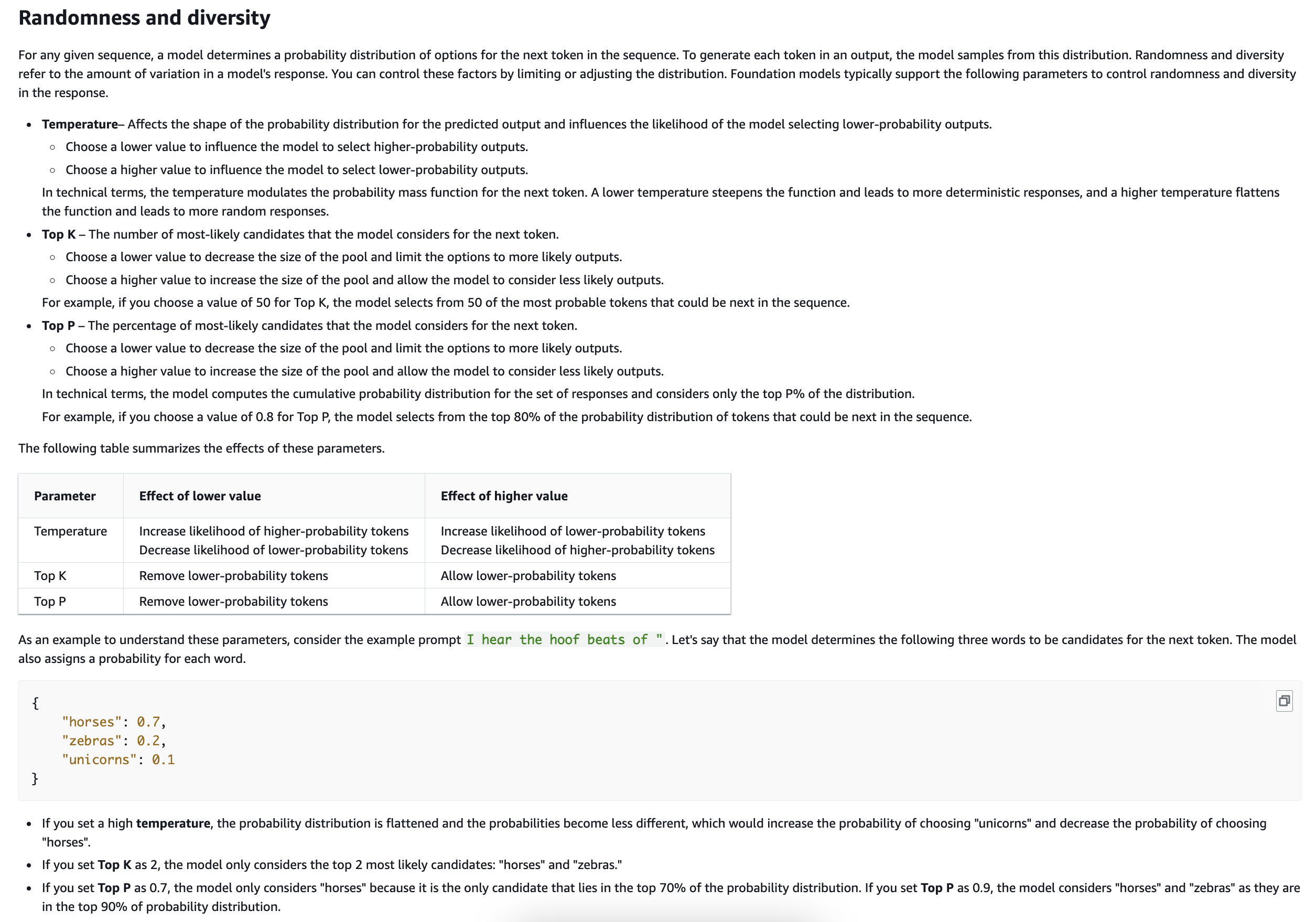
Randomness Diversity
- Explanation:
Incorrect Answers
- A. Specifies the sequences of characters that stop the model from generating further tokens
- Explanation: The inference parameter
Stop sequencesspecifies the sequences of characters that stop the model from generating further tokens. If the model generates a stop sequence that you specify, it will stop generating after that sequence.
- Explanation: The inference parameter
- B. Influences the likelihood of the model selecting lower-probability outputs
- Explanation: The inference parameter
Temperatureis a value between 0 and 1, and it regulates the creativity of the model's responses.
- Explanation: The inference parameter
- D. Influences the number of most-likely candidates that the model considers for the next token
- Explanation: The inference parameter
Top Krepresents the number of most likely candidates that the model considers for the next token.
- Explanation: The inference parameter
References:
Question 4
A company is using Amazon Bedrock and it wants to set an upper limit on the number of tokens returned in the model's response.
Which of the following inference parameters would you recommend for the given use case?
- A. Response length
- B. Stop sequence
- C. Top P
- D. Top K
Correct Answer
- A. Response length
- Explanation: Response length represents the minimum or maximum number of tokens to return in the generated response. Setting this parameter configures the upper limit on tokens returned.
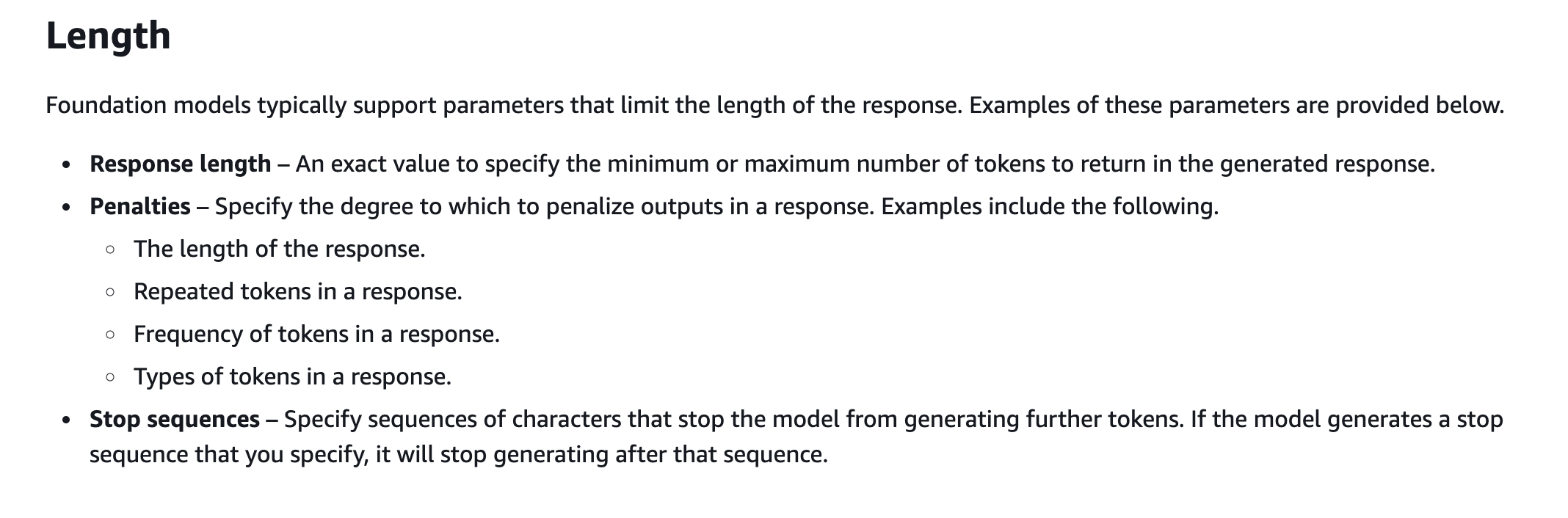
- Explanation: Response length represents the minimum or maximum number of tokens to return in the generated response. Setting this parameter configures the upper limit on tokens returned.
Incorrect Answers
- B. Stop sequence
- Explanation: Stop sequences specify the sequences of characters that stop the model from generating further tokens once encountered, rather than setting a strict numeric upper limit on tokens.
- C. Top P
- Explanation: Top P controls output diversity by representing the cumulative percentage cutoff of the most likely candidates the model considers for the next token (nucleus sampling).
- D. Top K
- Explanation: Top K limits pool selection to a specific count of the most likely candidates the model considers for the next token.
Reference: