What is Prompt Engineering?
Key Takeaways
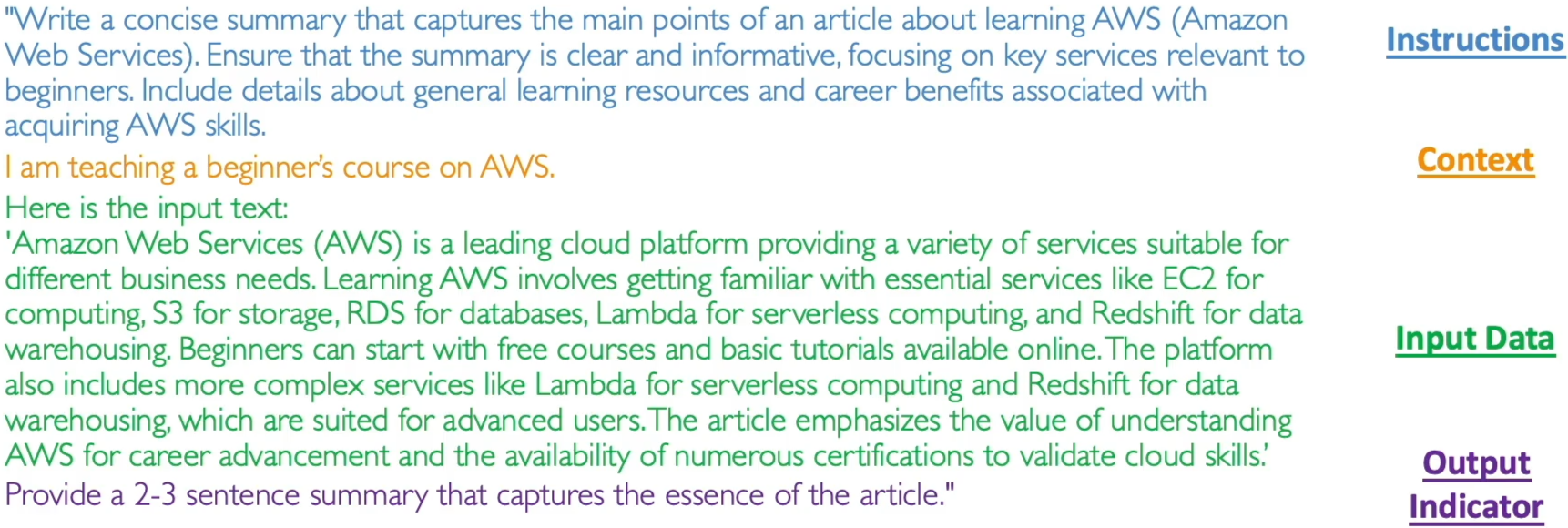
Prompt engineering is the systematic design and optimization of input text to guide Foundation Models (FMs) toward accurate, deterministic, and context-aligned responses. Instead of relying on naive, open-ended queries (e.g., "Summarize what is AWS"), enterprise prompts use Four Core Structural Blocks:
| Block | Description |
|---|---|
| 1. INSTRUCTIONS | The explicit task and behavioral guidelines |
| 2. CONTEXT | External background information and target audience persona |
| 3. INPUT DATA | The raw text, document, or data to be processed |
| 4. OUTPUT INDICATOR | The exact format, length, or structural constraint |
To narrow model boundaries further, Negative Prompting explicitly defines what the model must exclude or avoid, eliminating irrelevant details, hallucinations, and unwanted technical jargon.
Main Discussion
The Four Pillars of Prompt Construction
When designing prompts for Amazon Bedrock or any LLM, organizing input into four distinct components minimizes ambiguity and improves consistency:
| Component | Definition | Concrete Exam Example |
|---|---|---|
| 1. Instructions | Specifies the exact task to perform and behavioral rules. | "Write a clear, concise summary focusing on core cloud services." |
| 2. Context | Background situation, domain role, or target audience persona. | "You are teaching a beginner-level cloud foundations class." |
| 3. Input Data | The raw content, article text, or data records being analyzed. | <article> AWS provides on-demand compute and storage... </article> |
| 4. Output Indicator | Explicit schema, word count, tone, or structural formatting output. | "Provide a 2-3 sentence summary in a bulleted list format." |
Negative Prompting: Establishing Clear Negative Constraints
Negative Prompting tells the model what not to do. While positive instructions define the target output, negative constraints prevent common generation pitfalls:
| Positive Guidance (What to include) | Negative Constraints (What to exclude) |
|---|---|
| _ Explain core benefits of AWS S3 _ Focus on storage durability * Write for beginner learners | _ Do NOT use complex technical jargon _ Avoid mentioning pricing numbers or quotas * Exclude speculative future capabilities |
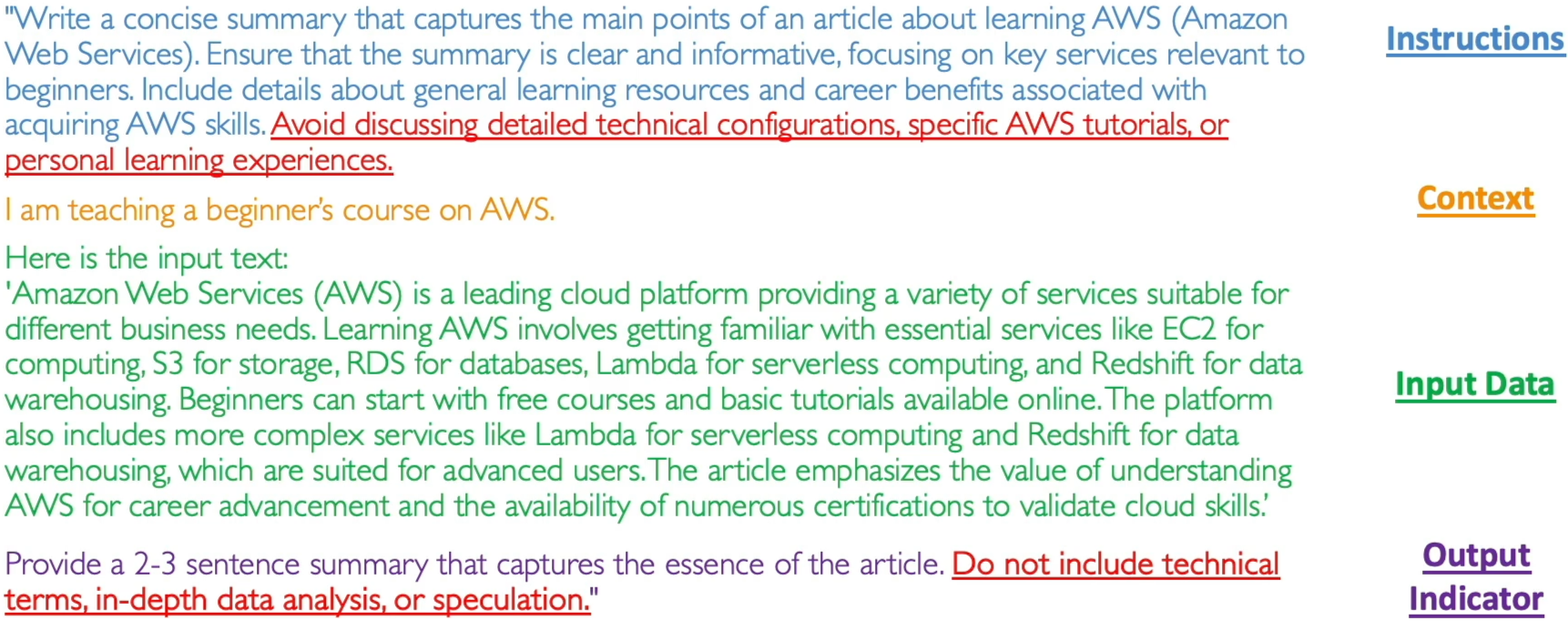
- Reduces Unwanted Content: Directly suppresses off-topic remarks, speculative answers, or unverified claims.
- Preserves Topic Focus: Keeps multi-turn conversations anchored strictly to the intended business scope.
- Improves Output Readability: Prevents the LLM from leaking overly complex implementation code when addressing non-technical users.
Exam Guide
Exam Tips
- Identify the Four Prompt Elements: The exam frequently presents prompt snippets and asks you to identify the missing structural component (e.g., if a prompt provides a task, context, and data but forgets length/schema rules, it lacks the Output Indicator).
- Negative Prompting Purpose: When a scenario asks how to stop a model from outputting sensitive internal jargon, code snippets, or overly verbose commentary without retraining, the answer is Negative Prompting.
- Prompt Optimization Order: Always apply structured prompt engineering (instructions, context, formatting boundaries, and negative prompts) before reaching for more complex and costly methods like fine-tuning.
Practice Test
Question 1
A marketing manager writes the following prompt for Amazon Bedrock: "Summarize our quarterly release notes into two paragraphs for non-technical retail customers. Do not include internal bug tracker IDs or code syntax." Which two prompt engineering techniques are being used in this prompt? (Select TWO.)
- A. Negative Prompting
- B. Model Distillation
- C. Output Indicator
- D. Supervised Fine-Tuning
- E. Continued Pre-training
Correct Answer
- A. Negative Prompting
- C. Output Indicator
- Explanation: Specifying "Do not include internal bug tracker IDs or code syntax" is an explicit example of Negative Prompting. Specifying "into two paragraphs for non-technical retail customers" defines the target structure and length, serving as an Output Indicator paired with context.
Question 2
An AI developer provides a foundation model with an extensive text article and asks: "Extract all action items." The model returns a lengthy conversational paragraph with extra commentary rather than a clean list. Which core prompt engineering block should the developer add to enforce a concise bulleted list?
- A. Input Data
- B. Output Indicator
- C. Embeddings Vector
- D. Contextual Grounding Check
Correct Answer
- B. Output Indicator
- Explanation: An Output Indicator specifies the exact structure, format, length, or schema (e.g., "Format your response as a numbered bullet list containing only action items") required from the model.