Compliance for AI: Regulatory Frameworks, Audit Challenges & Lineage Documentation
Key Takeaways
AI Compliance requires organizations in regulated industries (such as financial services, healthcare, aerospace, and public sector) to ensure that machine learning systems adhere to legal statutes, regulatory requirements, and international security standards.
- Core AI Compliance Challenges: Auditing AI systems is uniquely difficult due to opacity/complexity (black-box neural networks), dynamism/drift (models changing over time), emergent capabilities, and systemic bias (both historical data bias and developer bias).
- Global Regulatory Landscapes: Prominent frameworks include the EU Artificial Intelligence Act (EU AI Act), the NIST AI Risk Management Framework (NIST AI RMF), ISO/IEC 42001, GDPR, HIPAA, and PCI-DSS.
- Compliance on AWS: AWS maintains over 140 compliance accreditations for underlying infrastructure, while offering Amazon SageMaker Model Cards (for customer model lineage and training factsheets) and AWS AI Service Cards (for AWS-managed service transparency) to satisfy audit requirements.
Main Discussion
The Inherent Challenges of AI Compliance
Traditional software validation relies on deterministic code paths and predictable execution rules. Machine learning compliance introduces distinct verification hurdles:
| Challenge | Root Cause | Regulatory Consequence |
|---|---|---|
| Opacity & Complexity | Multi-billion parameter weights make internal tracing impractical. | Violates transparency and "right to explanation" mandates in credit, insurance, and judicial scoring. |
| Dynamism & Drift | Real-world consumer behavior evolves, causing input data to diverge from training baselines. | A model deemed compliant at launch may violate accuracy or fairness thresholds months later. |
| Emergent Capabilities | Foundation models trained on vast web corpora exhibit unforeseen functional capabilities. | Exposes organizations to unauthorized tasks, safety risks, or accidental policy violations. |
| Algorithmic & Human Bias | Historical training data reflects historical human bias or class underrepresentation (e.g., medical imagery predominantly featuring male subjects). | Violates anti-discrimination laws and equal protection mandates (e.g., Fair Housing Act, Equal Credit Opportunity Act). |

Global Regulatory Standards & Compliance Frameworks
| Compliance Framework | Jurisdiction / Scope | Primary AI Relevance |
|---|---|---|
| EU Artificial Intelligence Act (EU AI Act) | European Union (Extraterritorial impact) | Establishes a risk-based regulatory framework: • Unacceptable Risk: Prohibited (e.g., social scoring). • High Risk: Strict compliance, logging, risk management, and human oversight (e.g., hiring, medical devices, critical infrastructure). • Limited/Minimal Risk: Transparency obligations (e.g., disclosing AI chatbots). |
| NIST AI Risk Management Framework (AI RMF) | United States / Global Standard | A voluntary guidance framework organized into four core functions: Govern, Map, Measure, and Manage AI risks. |
| ISO/IEC 42001 | International Standard | The certifiable international standard establishing requirements for an Artificial Intelligence Management System (AIMS). |
| GDPR | European Union | Enforces data minimization, purpose limitation, the right to erasure ("right to be forgotten"), and restrictions on automated profiling without human intervention. |
| HIPAA | United States (Healthcare) | Governs the handling, storage, and processing of Protected Health Information (PHI). |
| PCI-DSS | Global (Financial Transactions) | Governs the secure processing and transmission of credit card and cardholder account data. |
Compliance Implementation: Shared Responsibility & Model Cards
Under the AWS Shared Responsibility Model for Compliance, AWS provides compliance certifications for its physical data centers, networking, and managed AI services, while customers must ensure that their custom datasets, training pipelines, and applications meet industry regulations.
Documenting AI Lineage for Audits
- Amazon SageMaker Model Cards: Standardized digital artifacts that capture model lineage, training datasets, license compliance, evaluation metrics, and risk ratings into an auditable document.
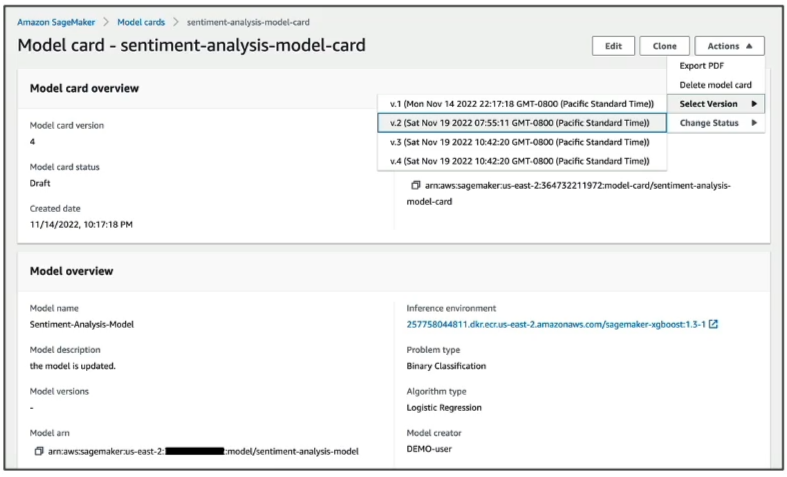
- AWS AI Service Cards: Public documentation provided by AWS for pre-trained AI services (e.g., Amazon Rekognition, Amazon Textract) that outline intended use cases, operating boundaries, and fairness design choices.
- AWS Artifact: A centralized AWS console portal providing on-demand access to AWS security and compliance reports (e.g., SOC reports, ISO certifications, BAA agreements).
Exam Guide
Exam Tips
- AI Audit Challenges: Be prepared to identify why AI compliance is unique: algorithmic opacity ("black box"), temporal drift, emergent capabilities, and historical data bias.
- Model Cards vs. Service Cards:
- Amazon SageMaker Model Cards: Customer-created compliance factsheets documenting custom ML model details (intended use, training datasets, licenses, evaluation metrics, and risk ratings).
- AWS AI Service Cards: AWS-published transparency factsheets detailing the scope, limitations, and responsible design of AWS-managed AI services.
- Major Framework Identification:
- EU AI Act: Landmark European legislation categorizing AI applications by risk tiers (Unacceptable, High, Limited, Minimal).
- NIST AI RMF: US framework centered on Govern, Map, Measure, and Manage functions.
- HIPAA: US healthcare standard for Protected Health Information (PHI).
- PCI-DSS: Global security standard for credit cardholder data.
- Shared Responsibility for AI Compliance: AWS certifies its cloud infrastructure and managed AI services; the customer is responsible for auditing custom training data, model outputs, and end-user compliance.
Practice Test
Question 1
A multinational enterprise is building a credit scoring machine learning model and must prepare for an external regulatory compliance audit. The compliance officers require a single, standardized document containing details on the model's intended use, training dataset origins, data licensing, risk level, and quantitative evaluation metrics. Which AWS feature directly provides this standardized documentation?
- A. Amazon SageMaker Model Cards
- B. AWS HealthScribe
- C. Amazon Polly Speech Marks
- D. Amazon Comprehend Custom Lexicons
Correct Answer
- A. Amazon SageMaker Model Cards
- Explanation: Amazon SageMaker Model Cards are standardized, centralized governance documents that record critical details about a machine learning model—including intended use, data lineage, licenses, risk ratings, and evaluation metrics—to support auditing and compliance requirements.
Question 2
An AI governance lead is reviewing global regulatory standards for high-risk generative AI applications. Which framework is a comprehensive, risk-tiered European Union regulation that categorizes AI systems into distinct risk levels (such as Unacceptable Risk and High Risk) and enforces strict transparency and oversight mandates?
- A. PCI-DSS
- B. EU Artificial Intelligence Act (EU AI Act)
- C. Amazon EC2 Service Level Agreement (SLA)
- D. AWS Acceptable Use Policy
Correct Answer
- B. EU Artificial Intelligence Act (EU AI Act)
- Explanation: The EU Artificial Intelligence Act (EU AI Act) is the landmark European Union regulation that classifies AI systems by risk tier (Unacceptable, High, Limited, Minimal Risk) and establishes strict transparency, documentation, and compliance obligations.
Question 3
A hiring platform is developing a machine learning model to help companies screen job candidates. During testing, the data science team notices that the model seems to favor certain demographic groups over others. The team suspects that the training data may reflect historical biases from previous hiring practices, leading to biased predictions. To address this issue, the team wants to understand how human bias can influence machine learning outcomes.
Which of the following represents the best-fit explanation for the given scenario?
- A. A machine learning algorithm predicts customer churn based on historical data, but the data is skewed due to seasonal trends
- B. An automated translation service frequently makes errors when translating idiomatic expressions between languages
- C. A data scientist selects features for a machine learning model based on their personal beliefs about which attributes are important, leading to a biased model
- D. A machine learning model trained on historical hiring data consistently recommends male candidates for technical roles
Correct Answer
- C. A data scientist selects features for a machine learning model based on their personal beliefs about which attributes are important, leading to a biased model
- Explanation: This scenario directly exemplifies human bias, where an individual's personal beliefs, subjective judgments, or cognitive biases directly influence decisions in the ML lifecycle (such as manual feature selection), resulting in a biased model.
Incorrect Answers
- A. A machine learning algorithm predicts customer churn based on historical data, but the data is skewed due to seasonal trends
- Explanation: This scenario describes temporal data skew or seasonality issues rather than human bias.
- B. An automated translation service frequently makes errors when translating idiomatic expressions between languages
- Explanation: This reflects general model limitations and language modeling performance on nuanced linguistic nuances rather than human bias.
- D. A machine learning model trained on historical hiring data consistently recommends male candidates for technical roles
- Explanation: While rooted in societal history, this specific outcome illustrates historical or algorithmic bias in the resulting model predictions originating from unbalanced training distributions rather than an explicit example defining human cognitive bias during development.
Reference: