Security & Privacy for AI: Defense-in-Depth, Shared Responsibility Model & Privacy-Enhancing Technologies
Key Takeaways
Securing artificial intelligence workloads requires applying defense-in-depth principles across data, model execution, infrastructure, and runtime guardrails.
Key security controls include:
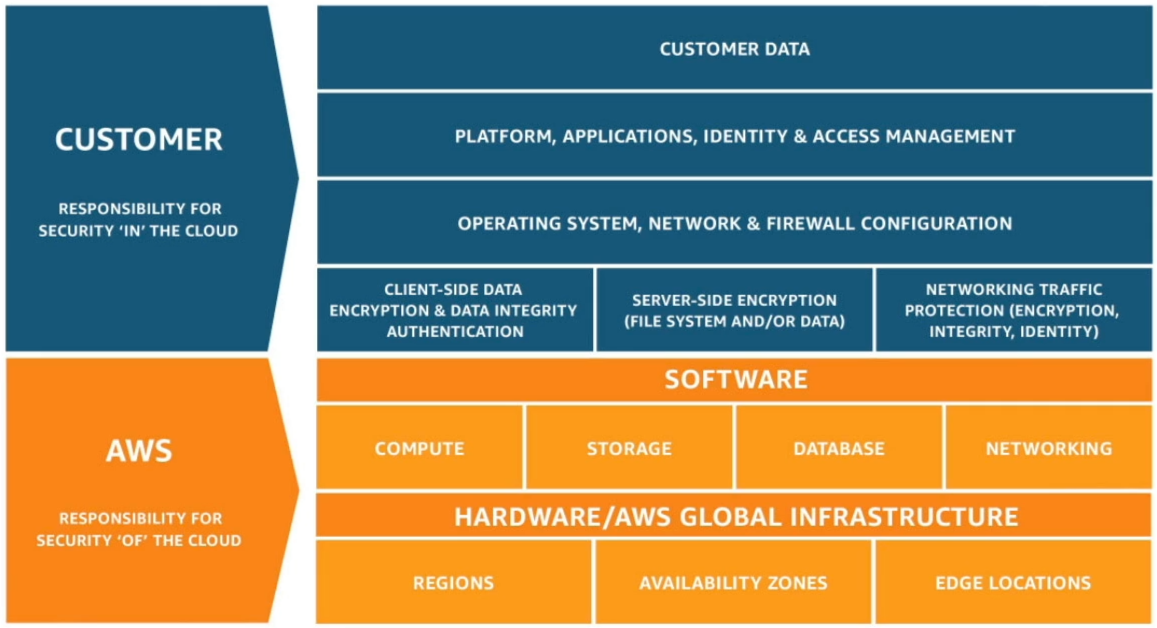
- The AWS Shared Responsibility Model for AI: AWS manages the security OF the cloud (physical data centers, managed compute, base service code), while the customer is responsible for security IN the cloud (data classification, IAM access policies, encryption configuration, and application guardrails).
- Privacy-Enhancing Technologies (PETs): Data masking, tokenization, PII discovery and sanitization (Amazon Macie, Amazon Comprehend), and least-privilege role-based access control (RBAC).
- AI Observability: Tracking both computational metrics (CPU/GPU utilization, latency) and algorithmic health (Precision, Recall, F1-Score, Data Drift).
Main Discussion
The AWS Shared Responsibility Model for AI & GenAI
The operational boundary between AWS and the customer depends on whether you run unmanaged infrastructure (EC2), managed ML platforms (SageMaker), or serverless Generative AI services (Amazon Bedrock).
| Component | AWS Responsibility ("OF" the Cloud) | Customer Responsibility ("IN" the Cloud) |
|---|---|---|
| Amazon EC2 (Self-Hosted AI) | Physical hardware, facility security, host virtualization layer. | Guest OS patching, software updates, firewall rules (Security Groups), CUDA/NVIDIA driver configuration, IAM policies, and data encryption. |
| Amazon SageMaker AI | Managed compute provisioning, ML execution container infrastructure, underlying OS patching, high availability. | Training script logic, notebook access policies, VPC/PrivateLink networking setup, training dataset classification, and Model Cards. |
| Amazon Bedrock (GenAI APIs) | Foundation model API hosting, base model infrastructure maintenance, serverless scaling, physical isolation. | Prompt design, Bedrock Guardrail configuration, fine-tuning data preparation, access management, and PII handling. |
| Shared Controls | Patch management (AWS patches cloud services; customers patch OS/applications), Configuration management, Awareness & Training. |
Privacy-Enhancing Technologies (PETs) & Data Protection
Protecting sensitive customer data (PII, PHI, financial records) requires combining cryptographic security with automated data sanitization:
| Privacy Control | Mechanism | Primary AWS Service / Feature |
|---|---|---|
| Sensitive Data Discovery | ML-powered pattern matching to scan Amazon S3 storage buckets for unprotected PII, credit cards, or credentials before model training. | Amazon Macie |
| PII / PHI Redaction | Identifying and masking personal entities within text payloads (e.g., names, SSNs, phone numbers) during ingestion or inference. | Amazon Comprehend / Comprehend Medical / Bedrock Guardrails |
| Data Masking & Obfuscation | Irreversibly altering sensitive demographic identifiers in training datasets to protect individual privacy while preserving statistical utility. | SageMaker Canvas / Glue DataBrew |
| Encryption at Rest & In Transit | Encrypting training data, model checkpoints, and EBS volumes at rest; securing API payloads in transit via TLS 1.3. | AWS KMS & Amazon VPC PrivateLink |
Model Performance & Operational Monitoring Metrics
Continuous production monitoring evaluates both algorithmic accuracy and compute infrastructure health:
- Precision: Critical when the cost of a False Positive is severe (e.g., spam filtering or fraud flagging where innocent users should not be blocked).
- Recall: Critical when the cost of a False Negative is severe (e.g., medical pathology detection or airport threat detection where missing a positive case is catastrophic).
- F1-Score: The harmonic mean of precision and recall, providing a balanced metric on imbalanced datasets.
Enterprise Access Control & Least Privilege
- Role-Based Access Control (RBAC): Defining distinct IAM execution roles for each persona (Data Scientists, Data Engineers, MLOps Engineers) using SageMaker Role Manager.
- Least-Privilege Principle: Granting users and services only the minimum permissions necessary to perform their specific tasks (e.g., allowing an inference endpoint to read model artifacts from S3, but prohibiting write or delete actions).
- Private Connectivity: Routing traffic privately through Amazon VPC Endpoints (AWS PrivateLink) so training and inference traffic never traverses the public internet.
Exam Guide
Exam Tips
- Shared Responsibility Model for AI (High Frequency):
- AWS Responsibility: Security OF the cloud (physical infrastructure, hardware, hypervisors, foundational Bedrock model hosting, managed patching).
- Customer Responsibility: Security IN the cloud (data classification, customer-managed KMS keys, IAM policies, Guardrail setup, training data privacy).
- Sensitive Data Discovery vs. PII Masking:
- To scan S3 buckets and identify sensitive data/PII at scale Amazon Macie.
- To redact PII from real-time text or prompt inputs Amazon Comprehend / Guardrails for Amazon Bedrock.
- Metric Triggers:
- Precision: Use when minimizing False Positives is the priority.
- Recall: Use when minimizing False Negatives (missing positive cases) is the priority.
- F1-Score: The metric to optimize when evaluating imbalanced datasets where both precision and recall matter.
- Privacy-Enhancing Technologies (PETs): Look for keywords like data masking, tokenization, and anonymization to protect user privacy without degrading model training capability.
- Network Isolation: Training sensitive models without outbound internet or external VPC access is achieved via SageMaker Network Isolation Mode.
Practice Test
Question 1
Under the AWS Shared Responsibility Model, which security task is the direct responsibility of the customer when deploying a Generative AI application using foundation models on Amazon Bedrock?
- A. Applying firmware updates to physical GPU hardware in AWS data centers
- B. Configuring Guardrails for Amazon Bedrock and managing IAM access permissions
- C. Managing the physical environmental controls of AWS facilities
- D. Patching the underlying operating system hosting the managed Bedrock API
Correct Answer
- B. Configuring Guardrails for Amazon Bedrock and managing IAM access permissions
- Explanation: In the AWS Shared Responsibility Model for managed services like Amazon Bedrock, the customer is responsible for security in the cloud—including configuring application guardrails, defining IAM access policies, managing data classification, and encrypting client data. AWS manages the physical facilities, hardware, and underlying managed service software.
Question 2
A healthcare organization is preparing a large corpus of patient consultation transcripts stored in Amazon S3 for an internal machine learning training pipeline. Before training starts, the security lead must ensure that any unprotected Personally Identifiable Information (PII) stored within the S3 buckets is automatically discovered and flagged. Which AWS service should be used?
- A. AWS Trusted Advisor
- B. Amazon Macie
- C. Amazon Polly
- D. AWS HealthScribe Evidence Mapping
Correct Answer
- B. Amazon Macie
- Explanation: Amazon Macie is a fully managed data security and privacy service that uses machine learning and pattern matching to discover, monitor, and protect sensitive data (such as PII and financial records) in Amazon S3.
Question 3
In the context of security and privacy for AI systems on AWS, what is the primary difference between threat detection and vulnerability management?
- A. Threat detection is concerned with data encryption and access controls, while vulnerability management deals with incident response and recovery
- B. Threat detection focuses on identifying potential weaknesses in the system, while vulnerability management continuously monitors for malicious activities
- C. Threat detection and vulnerability management both exclusively focus on compliance with regulatory requirements
- D. Threat detection involves real-time monitoring and identification of active threats, whereas vulnerability management is about identifying, assessing, and mitigating security weaknesses
Correct Answer
- D. Threat detection involves real-time monitoring and identification of active threats, whereas vulnerability management is about identifying, assessing, and mitigating security weaknesses
- Explanation: Threat detection services, such as Amazon GuardDuty, continuously monitor the environment to identify active threats and malicious activities in real time, providing alerts and insights to respond promptly. Vulnerability management, on the other hand, focuses on proactively identifying, assessing, and mitigating security vulnerabilities before they can be exploited. This involves regular scanning, patch management, and implementing security best practices.
Incorrect Answers
- A. Threat detection is concerned with data encryption and access controls, while vulnerability management deals with incident response and recovery
- Explanation: Data encryption and access controls are part of broader security practices, not specifically threat detection. Vulnerability management is about identifying and mitigating weaknesses, not incident response and recovery.
- B. Threat detection focuses on identifying potential weaknesses in the system, while vulnerability management continuously monitors for malicious activities
- Explanation: This statement reverses the roles. Threat detection is about identifying active threats and malicious activities, whereas vulnerability management is about identifying potential weaknesses in the system.
- C. Threat detection and vulnerability management both exclusively focus on compliance with regulatory requirements
- Explanation: Both practices contribute to regulatory compliance but have much broader operational roles. Threat detection focuses on real-time threat identification, while vulnerability management deals with addressing structural security weaknesses.
Reference: