S3 Default Encryption
While S3 automatically applies a fallback encryption state of SSE-S3 to every single inbound object out of the box, developers utilize S3 Bucket Policies to preemptively intercept and strictly reject requests that do not specify an explicit, mandated cryptographic encryption header (such as aws:kms or SSE-C parameters). Because Bucket Policies are evaluated before Default Encryption settings, a policy-driven Deny statement overrides everything else, serving as a hard automated compliance gate.
Key Takeaways
The Core Security Law
Write this down inside your memory logs, because the DVA-C02 exam tests this exact logical execution sequence. When a client throws a PutObject HTTP request over the wire at your bucket, S3 evaluates the request context using a strict sequential hierarchy:
[ Inbound PutObject Request ]
                 │
                 ▼
 ┌──────────────────────────────┐
 │   1. Evaluate Bucket Policy  │  ◄─── Intercepts headers BEFORE default settings apply!
 └──────────────┬───────────────┘
                │
         (Is there a DENY?)
        ├──► YES ──► 🛑 [ 403 Access Denied ] (Request Dropped Immediately)
        └──► NO
                │
                ▼
 ┌──────────────────────────────┐
 │ 2. Check for Request Headers │
 └──────────────┬───────────────┘
                │
     (Are encryption headers present?)
        ├──► YES ──► 🔐 Encrypt using the request's specified cipher header.
        └──► NO
                │
                ▼
 ┌──────────────────────────────┐
 │ 3. Apply Default Encryption  │  ◄─── Server-side fallback safety net activates.
 └──────────────┬───────────────┘
                │
                ▼
   🔐 Encrypt using fallback bucket defaults (SSE-S3 or SSE-KMS).
Because Bucket Policies sit at Step 1, they can preemptively audit the incoming request headers before S3 ever gets a chance to apply its internal default encryption fallback logic. If a client attempts an upload that breaches your policy rules, S3 cuts the wire instantly.
Forcing Strict Compliance via Bucket Policies
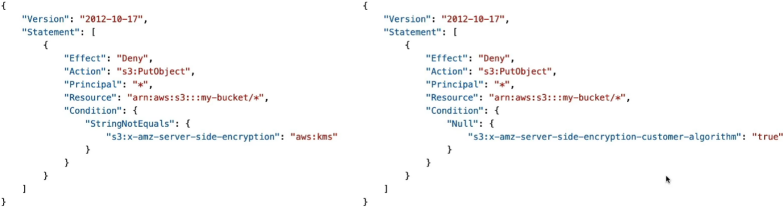
If your corporate security mandate states that data-at-rest must be protected by SSE-KMS for tracking and key rotation audits, relying on default encryption alone is a risk. Why? Because an external developer could explicitly pass the x-amz-server-side-encryption: AES256 header, which would override your bucket's default setting and force an unvetted SSE-S3 encryption layer instead!
To block this loophole, you write an explicit Deny Bucket Policy Statement:
Exam Tips
The Silent Client-Side Deny Trap: Imagine an exam scenario states, "You configure a secure S3 bucket with default encryption set to SSE-KMS. To guarantee maximum compliance, you attach a bucket policy that explicitly DENIES any s3:PutObject request if the s3:x-amz-server-side-encryption condition key is missing or not equal to aws:kms.
A developer on your team tries to run a standard upload script without any encryption flags: aws s3 cp file.txt s3://my-bucket/. They expect the bucket's default SSE-KMS setting to catch it safely, but the command throws an Access Denied error instead. Why?"
The textbook developer answer rests entirely on the evaluation sequence. > Since the developer fired a standard raw upload command without flags, the request carried no encryption headers.
When the request hit Step 1, your bucket policy evaluated the missing header against the Deny condition block. Because the request failed to explicitly pass aws:kms inside the HTTP payload headers, the policy triggered a hard Deny override immediately.
S3 never even reached Step 3 to apply its internal default encryption fallback! To fix this script, the developer must explicitly append the encryption flag modifier straight to their terminal payload request command: