CloudFormation - Intrinsic Functions
AWS CloudFormation templates aren't just rigid files; they are highly dynamic thanks to Intrinsic Functions. These functions allow you to perform real-time variable injection (!Ref), dig deep into a resource to pull specific live infrastructure data (!GetAtt), encode configuration bootstrap scripts for EC2 instances (!Base64), and link detached infrastructure components together (!ImportValue). Mastering these functions is all about knowing exactly what value each function extracts and how to use their clean YAML shorthands.
Key Takeaways
- Must know intrinsic functions for DVA-C02:
!Ref,!GetAtt,!Base64,!FindInMap,!ImportValueand Condition functions (!Equals,!And,!Not). - Other intrinsic functions that exist but are not tested on the exam include:
!Join,!Sub,!ForEach,!ToJsonString,!Cidr,!GetAZs,!Select,!Split,!Transformand!Length. You can find the full list in the AWS documentation.
Deep Dive
The !Ref Function
- Mechanics: The baseline tracking function.
- Return Behavior: As we discussed in our parameters overview,
!Refplays two different roles depending on the input argument:- Passed a Parameter Name → Returns the literal value provided by the user.
- Passed a Resource Logical ID → Returns the core unique identifier (the physical ID) of that resource (e.g., returning an
i-0xxxxxxstring for anAWS::EC2::Instance).
Resources:
  DBSubnet1:
    Type: AWS::EC2::Subnet
    Properties:
      VpcId: !Ref MyVPC
The !GetAtt (Get Attribute) Function
- Mechanics: While
!Refonly gives you the baseline ID of a resource,!GetAttlets you drill down to retrieve highly specific structural properties generated after the resource is provisioned. - Return Behavior: You can only extract attributes explicitly exposed by AWS in the official documentation. For an
AWS::EC2::Instance,!GetAttcan retrieve attributes like:PrivateIporPublicIpPrivateDnsNameorPublicDnsName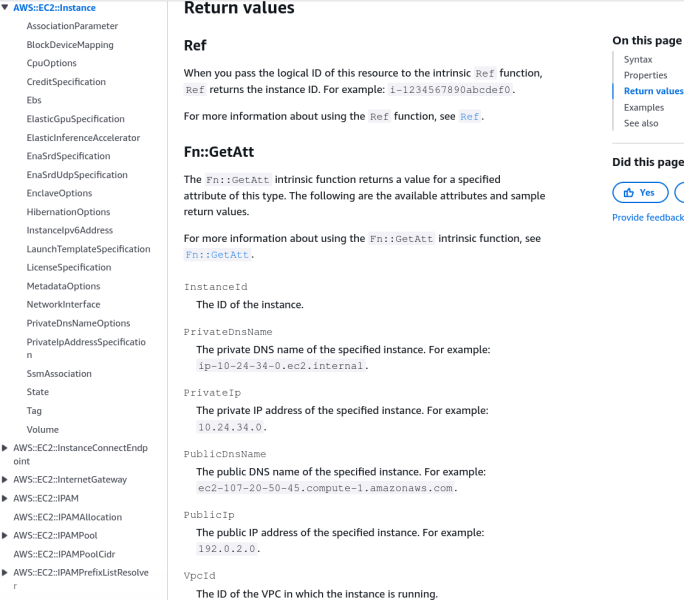
- Syntax: Expressed as an array sequence or dot-notation string:
!GetAtt MyEC2Instance.PublicDnsName. - Real-World Case: Imagine you need to provision a public web server and automatically map its address to an Amazon Route 53 DNS record stack. You use
!GetAtt MyEC2Instance.PublicDnsNameto dynamically pipe the live server address straight into the Route 53 resource record block.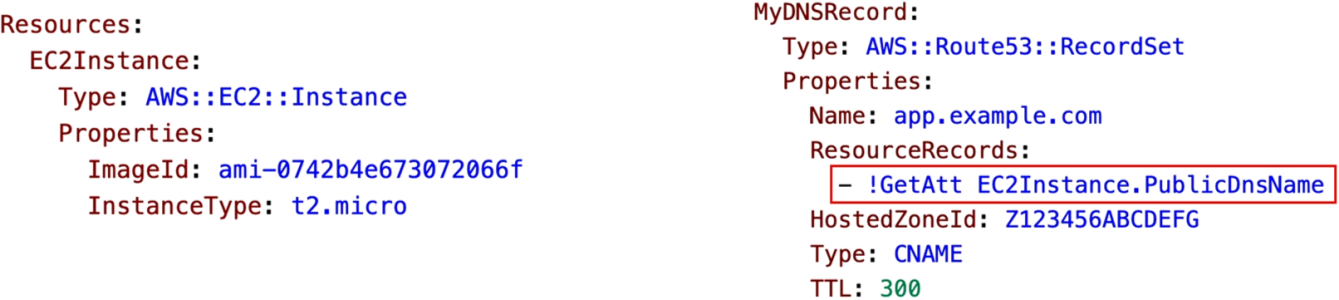
The !Base64 Function
- Mechanics: Converts an unencoded plain text string into a Base64-encrypted format string.
- Primary Use Case: Enforcing compliance when writing custom EC2 UserData scripts. The AWS virtualization layer requires all initialization launch scripts passed to an instance to be encoded in
Base64format. You wrap your startup script block with!Base64to handle this transformation automatically.
Resources:
  WebServer:
    Type: AWS::EC2::Instance
    Properties:
      UserData:
        !Base64 |
          #!/bin/bash
          dnf update -y
          dnf install -y httpd
Reviewing Core Logic & & Lookup Helpers
!FindInMap: Extracts a hardcoded attribute from a nested multidimensional table array based on regional or environmental keys.!ImportValue: Reaches outside the boundaries of the local template to pull in globally exported asset IDs (like a core VPC ID) published by independent producer stacks.- Condition Functions (
!Equals,!And,!Not): Evaluates dynamic environmental states down to a binary logic gate to determine if a resource should compile or stay unprovisioned.
Exam Tips
!Refvs.!GetAttSelection Criteria: This is a classic exam favorite. If a question scenario asks you to pass the Instance ID of an EC2 instance to another resource, use!Ref. If it asks you to pass the Public IP Address or Availability Zone of that instance, you must select!GetAtt.- The UserData Requirement Pattern: If you see an exam question detailing an issue where a shell bootstrap configuration script inside an EC2 instance's
UserDataproperty is failing to execute because the text format is improper, look for an answer that wraps the script block with the!Base64intrinsic function wrapper.
Practice Test
Question 1: A developer is constructing an AWS CloudFormation template to deploy an application cluster. The template contains an AWS::EC2::Instance resource with the logical ID ApplicationServer. The developer also needs to configure an Amazon Route 53 Record Set resource within the same template, which requires the public IP address of the newly spun-up instance to resolve the routing destination. Which syntax string should the developer use to dynamically fetch this value?
-
!Ref ApplicationServer -
!GetAtt ApplicationServer.PublicIp -
!ImportValue ApplicationServer.PublicIp -
!FindInMap [ ApplicationServer, PublicIp ]
Correct Answer
-
!GetAtt ApplicationServer.PublicIp- Explanation: While the
!Reffunction only yields the core physical asset instance ID string, the!GetAttfunction allows you to drill down into the resource specification catalog to extract post-provisioned contextual attributes, such asPublicIp, at deployment runtime.
- Explanation: While the
Question 2: As an AWS Certified Developer Associate, you are writing a CloudFormation template in YAML. The template consists of an EC2 instance creation and one RDS resource. Once your resources are created you would like to output the connection endpoint for the RDS database.
Which intrinsic function returns the value needed?
- !GetAtt
- !Sub
- !Ref
- !FindInMap
Correct Answer
- !GetAtt
- Explanation: The
Fn::GetAtt(or!GetAttin YAML) intrinsic function returns the value of a specific attribute from a resource in the template. For an RDS DB instance, resource attributes likeEndpoint.AddressorEndpoint.Portare retrieved at runtime using!GetAtt.
- Explanation: The
- !Sub
- Explanation: The
Fn::Subintrinsic function substitutes variables in an input string with values that you specify. While it can format strings, it does not fetch resource attributes directly.
- Explanation: The
- !Ref
- Explanation: The
Refintrinsic function returns the value of a specified parameter or resource identifier (for an RDS instance,!Refreturns its logical ID / DB instance identifier, not its connection endpoint).
- Explanation: The
- !FindInMap
- Explanation: The
Fn::FindInMapintrinsic function returns the value corresponding to keys in a two-level map declared in theMappingssection of the CloudFormation template.
- Explanation: The