SQS - Dead-Letter Queues Hands On

🛠️ Hands On DLQ & Redrive Console Playbook

Step 1: Provision the Dead-Letter Queue

  • Go to the Amazon SQS Dashboard, click Create queue, select Standard, and name it DemoQueueDLQ.
  • In the Redrive allow policy section, select Enabled and set the permission to Allow all. This is to identify which source queues are allowed to use this queue as a DLQ target.
  • Set the Message retention period to 14 days to give yourself maximum time to debug errors, then hit create.
  • Open your primary DemoQueue, click Edit, and drop the Visibility timeout to 5 seconds (just to make testing snappy).
  • Scroll down to the Dead-letter queue panel, toggle it to Enabled, and select your newly built DemoQueueDLQ.
  • Set the Maximum receives (maxReceiveCount) threshold to 3. Hit save.

Step 3: Simulate the "Poison Pill" Failure

  • In DemoQueue, hit Send and receive messages, type hello world, poison pill into the body, and send it.
  • Click Poll for messages. SQS will serve the message. Let the 5-second timer run down without deleting it.
  • Watch the dashboard poll it a 2nd and 3rd time. On the 4th cycle, the message will completely vanish from the primary queue.

Step 4: Inspect the Isolated Message

  • Head over to the DemoQueueDLQ dashboard and click Poll for messages.
  • Boom! The malformed payload is sitting there safe and isolated, preventing your main consumer loop from breaking.

Step 5: Execute a DLQ Redrive

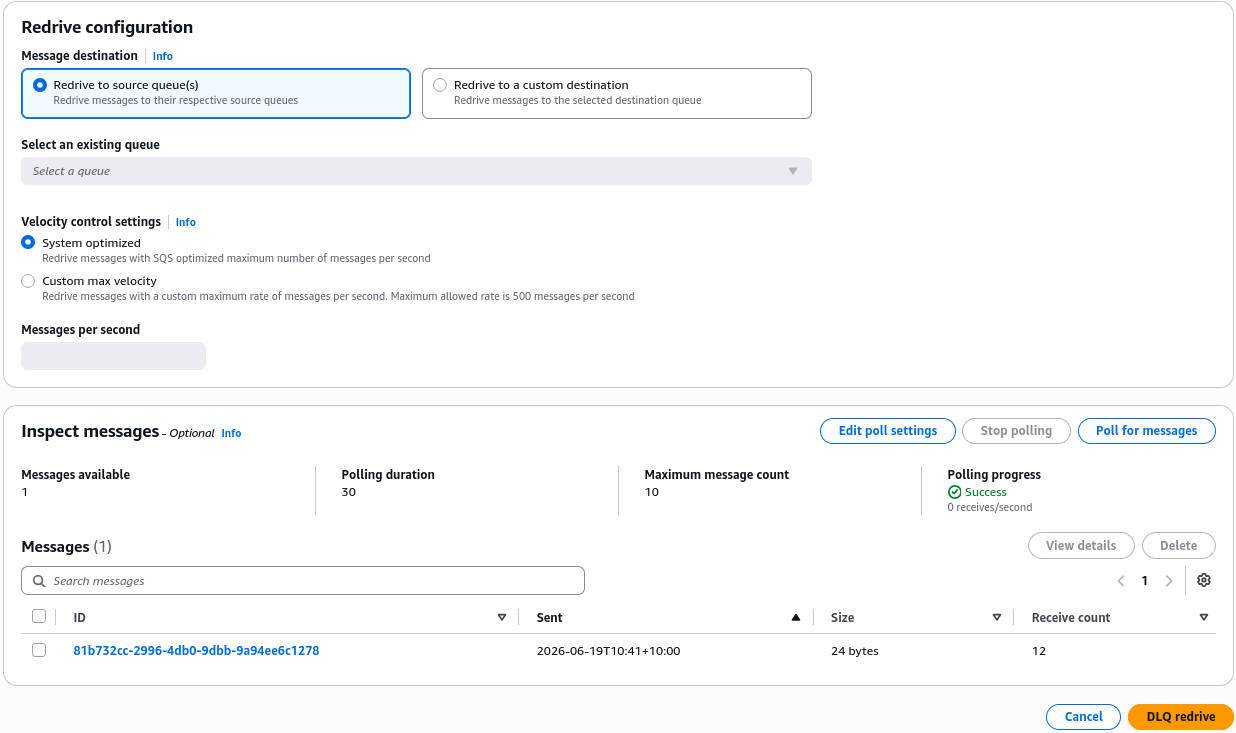
  • Inside your DLQ dashboard, click the Start DLQ redrive button in the top right corner.
  • Keep the default Redrive to source queue setting checked and click Start DLQ redrive.
  • Return to your primary DemoQueue, poll again, and you'll see the payload has jumped straight back home, ready for a fresh attempt!

Exam Tips

  • The Max Receives Count Mechanics: Pay attention to how the math works here, chief. If the exam specifies that a queue has a maxReceiveCount of 3, the message is sent to the DLQ on the 4th attempt to receive it, after failing 3 times.
  • Velocity Control on Redrive: When setting up a DLQ redrive task, SQS gives you a feature called Velocity Control. You can choose to push the messages back at a "System optimized" speed, or set a custom maximum message-per-second limit. If a question asks how to redrive dead-letter payloads without overwhelming your backend databases with a massive sudden spike of work, the answer is to configure a custom velocity limit during the DLQ redrive.