SQS - FIFO Queues Advanced
Advanced SQS FIFO management relies on two key pillars: 5-Minute Window Deduplication and Message Group ID Isolation.
- Deduplication uses either automated SHA-256 body hashing or explicit ID tokens to block duplicate network retries from entering the queue.
- Message Grouping breaks a single queue into multiple independent logical streams. By locking each unique Group ID to a single consumer thread, SQS FIFO enables massive parallel horizontal scaling while still preserving strict chronological ordering within each individual group.
Key Takeaways
Advanced Deduplication Mechanics
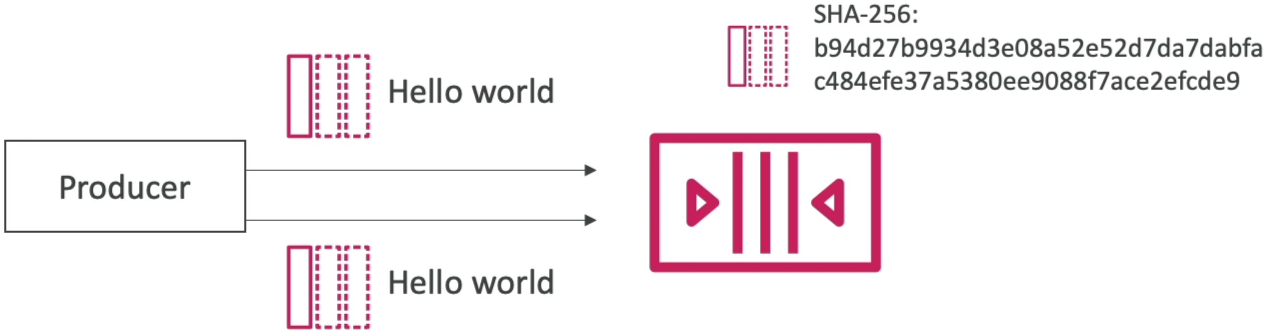
Whenever a producer publishes a message to a FIFO queue, SQS spins up a 5-minute sliding deduplication clock. If an identical message breaks into that window, SQS ignores it completely.
You can configure this protection guardrail using two distinct methods:
- Content-Based Deduplication: Once enabled, you don't have to pass any extra tokens. The second the payload hits the API gateway, SQS runs a SHA-256 hashing algorithm on the raw message body. If an incoming message generates a matching hash within 5 minutes, it is instantly refused.
- Explicit Message Deduplication ID: You manually pass a unique token string (like a transaction UUID) with the
SendMessagecall. SQS ignores the text content entirely and evaluates duplication strictly by matching the explicit token strings.
Message Group IDs: The Secret to Parallel Scale
A common misconception is that a FIFO queue limits you to a single consumer instance running at a sluggish 300 messages per second. That is wrong, bro. You can scale horizontally by designing smart Message Group IDs.
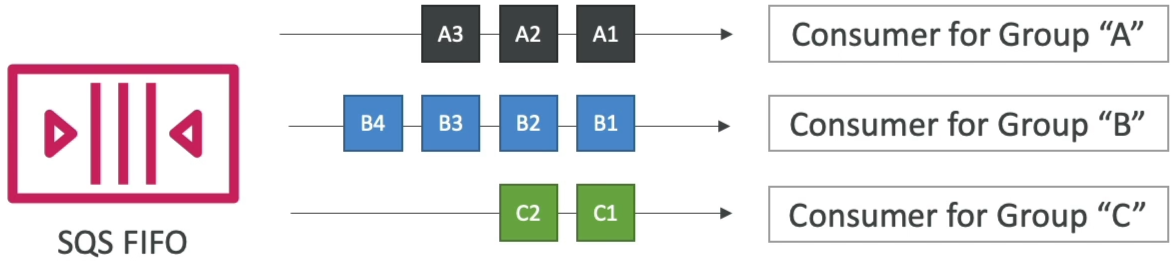
- The Ordering Boundary: Strict first-in, first-out sequencing is only guaranteed within messages that share the exact same Message Group ID. There is zero ordering guarantee across different group streams.
- The Consumer Lock: SQS temporarily locks an entire Message Group ID to a single consumer thread. While Worker 1 is crunching through messages for
Group_ID: user123, Worker 2 can simultaneously pull messages forGroup_ID: user234. - The Scale Equation: The maximum number of parallel consumers you can deploy matches the number of unique, active Message Group IDs flowing through your pipeline.
🛠️ Step-by-Step Advanced FIFO Playbook
Step 1: Activate the Hashing Shield
- Select your
.fifoqueue in the console, hit Edit, check the box for Content-based deduplication, and save.
Step 2: Test the Duplicate Blockade
- Go to Send and receive messages. Type
hello worldin the body, set the Group ID todemo, and send. The available message count bumps to1. - Spam the Send message button 4 more times with the exact same text. Refresh the page. The available count stays locked at
1because the SHA-256 hashes matched perfectly. - Type
hello world 2and send. The count immediately bumps to2.
Step 3: Simulate User-Level Isolation (Grouping)
- Send three messages back-to-back:
bought apple,bought banana,bought strawberry. Set the Message group ID for all three touser123. SQS chains these sequentially forUser 123. - Send a fourth message:
bought green apple. Set its Message group ID touser234. - SQS will now allow two separate worker nodes to pull these user streams simultaneously in parallel without any cross-contamination.
Exam Tips
- The Multi-Tenant Scaling Strategy: If the exam asks you to design a high-throughput architecture for a multi-tenant application where data sequencing must be preserved per client but processed at massive scale globally, the correct answer is to Use an SQS FIFO queue and assign the unique Customer ID as the Message Group ID.
- The Network Timeout Duplication Fix: Look out for scenarios where a mobile app producer frequently times out due to patchy cellular networks, causing it to retry and submit the same transaction twice. The fix is to Implement explicit Message Deduplication IDs based on a client-generated transaction UUID to let SQS catch and drop the duplicate retries within the 5-minute window.
Practice Test
Question: A senior developer is architecting a real-time banking notification backend using an Amazon SQS FIFO queue. The system processes account update events that must be executed in strict sequence for each individual bank account. However, during high-volume payroll days, the processing pipeline bottlenecks because a single consumer instance cannot keep up with the global queue depth. How can the developer refactor the message design to enable parallel processing while guaranteeing strict sequencing per account?
- A. Trigger a
PurgeQueueAPI action string immediately when the queue depth matches the instance threshold count. - B. Configure the producer application to use the unique Account Number as the Message Group ID parameter for every message sent.
- C. Switch the encryption tier from SSE-KMS over to a free SSE-SQS policy configuration wrapper.
- D. Re-upload the backend architecture inside a CloudFormation StackSet with an aggressive concurrent execution block.
Correct Answer: B. Passing the unique Account Number as the Message Group ID isolates the sequencing logic to individual accounts. This allows SQS to distribute separate account streams across a massive fleet of parallel consumers simultaneously, instantly shattering your scaling bottlenecks while preserving perfect chronological accuracy per account.