CloudTrail - EventBridge Integration
Instead of just recording a crime after it happens in a stagnant log file, this integration lets you build an active, serverless surveillance system. The moment a rogue user or broken script executes a destructive API call (like deleting a DynamoDB database or opening up a Security Group to the entire world), EventBridge intercepts the signature and instantly fires back with defensive measures—like blasting out an urgent text/email via SNS or triggering a Lambda function to roll back the change!
The CloudTrail-EventBridge Integration allows organizations to transform passive management log histories into reactive, real-time automation streams. When any control-plane API mutation is processed across an AWS account, CloudTrail logs the event while simultaneously passing a telemetry payload clone into the EventBridge Default Event Bus. Developers construct an EventBridge Rule containing a scoped JSON pattern matching specific API variables (such as eventName and eventSource), routing the matching payload to alerting or remediation targets like Amazon SNS.
Key Takeaways
Infrastructure Blueprint: The Automation Engine
To wire up this real-time alarm system, you bridge three distinct core services together into a single pipeline:
- The Event Generator (CloudTrail): Tracks the raw API handshake (e.g., a user clicking "Delete Table" in the console or running
aws dynamodb delete-tablein their terminal). - The Evaluator Routing Hub (EventBridge): Evaluates the ambient incoming account events against your custom-defined pattern.
- The Downstream Target (Amazon SNS / Lambda): Receives the automated event payload dump and carries out the real-world notification or infrastructure remediation code.
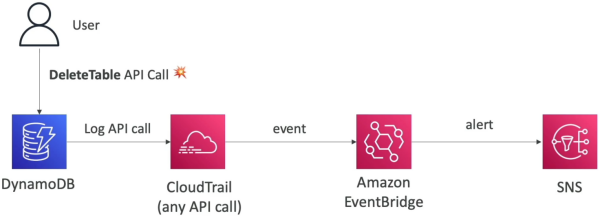
Dissecting the EventBridge Pattern Schema
To intercept a specific API deletion call, your EventBridge rule needs to parse the incoming structural JSON envelope. Here is the exact pattern blueprint you pass into the rule to catch someone blowing up a DynamoDB table:
{
  "source": ["aws.dynamodb"],
  "detail-type": ["AWS API Call via CloudTrail"],
  "detail": {
    "eventSource": ["dynamodb.amazonaws.com"],
    "eventName": ["DeleteTable"]
  }
}
🧠 Core Pattern Variables to Memorize:
source/eventSource: Binds the scoping lens to a specific AWS tool quadrant (e.g.,aws.iamfor credential management oraws.ec2for virtual networking).detail-type: Must be set explicitly to"AWS API Call via CloudTrail". This tells the bus to filter specifically for control-plane mutations coming down the audit pipeline.eventName: The exact API action method string you want to hunt down (e.g.,AssumeRolefor tracking access escalations, orAuthorizeSecurityGroupIngressfor catching wide-open network firewall adjustments).
📊 Operational Telemetry Pipeline Notation
The execution latency loops and payload distribution paths of reactive security boundaries map out according to these clean expressions:
Classic Enterprise Use-Case Matrix
You can apply this exact structural formula to solve an infinite number of governance challenges across your cloud sandbox:
- The IAM Access Tracer: Watch for
AssumeRoleAPI calls to verify whenever an engineer steps into a highly privileged cross-account administrator role.
- The Firewall Guardrail: Monitor
AuthorizeSecurityGroupIngressparameters. If a rule mapsCidrIp: 0.0.0.0/0on port 22 or 3389, route the trace to a Lambda function that instantly strips the rule away!
- The State Machine Sentinel: Track
CreateUserorDeleteLogGroupto build a real-time compliance slack-bot pipeline for your SysOps crew.
Exam Tips
- Real-Time Remediation Requirements: If an exam scenario says: "A company needs an automated, real-time notification system that fires within minutes of an administrator altering an IAM security control policy," the distractor choices will tell you to schedule a periodic Lambda cron-job that scans CloudTrail S3 logs every hour. Reject them. For instantaneous, event-driven responses, you must link CloudTrail events directly to an EventBridge Rule targeting SNS.
- Constructing the Pattern Filter: Look out for multi-choice selectors where you must select the correct JSON pattern mapping. Ensure that
detail-typeexplicitly reads"AWS API Call via CloudTrail", and that theeventNameuses the exact PascalCase notation string used by the underlying AWS service API, bro!
🚀 Practice Test
Scenario: A cloud security engineer wants to receive an instant email alert whenever an administrative user updates or changes an inbound firewall rule on an Amazon EC2 Security Group using the AuthorizeSecurityGroupIngress operation. Which architectural approach provides the lowest latency and requires minimal operational maintenance?
- A. Write a cron-style shell script running inside an EC2 instance that parses local system text files using a
PurgeQueuecondition loop string. - B. Configure an EventBridge Rule with an event pattern filtering for a
sourceofaws.ec2and aneventNameofAuthorizeSecurityGroupIngressvia CloudTrail. Set the rule's target directly to an Amazon SNS topic subscribed to the engineer's email. - C. Deploy an inline X-Ray Sampling Rule optimization pass across multi-region CloudFormation StackSets.
- D. Ingest raw console telemetry outputs into an SQS FIFO queue directory running on a strict message group ID layout.
Correct Answer: B. To get near zero-latency, completely serverless event handling whenever a management operation goes down, tapping CloudTrail's EventBridge hook to fan out an alert straight to SNS is the flawless, textbook cloud-native design pattern.