DynamoDB Partitioning Strategies
Write Sharding (or adding a synthetic partition key suffix) is the ultimate black-belt data modeling move for handling massive, high-concurrency traffic bursts targeting a narrow set of keys, bro! 🗳️💥
When you're building a system with massive scale—like a real-time voting application for a global event or a flash sale with a couple of hot items—you run straight into a hard architectural limitation if you model your data traditionally.
If millions of concurrent users blast votes for just two candidates (Candidate_A and Candidate_B), you only have two unique partition key values. DynamoDB runs those strings through its internal hashing loop and dumps 100% of that traffic onto exactly two physical storage partition drives, chief. Even if you provision a massive pool globally on the table, a single physical partition drive maxes out at 1,000 WCUs. You will hit a brick wall of massive Hot Partition Throttling (ProvisionedThroughputExceededException), crashing the voting lines!
Let's clean-room dissect the mechanics of Synthetic Key Sharding to distribute your data uniformly across the distributed tier.
Key Takeaways
🏗️ The Mechanics of Synthetic Sharding
To break the 1,000 WCU physical partition ceiling, your application code must inject a dynamic suffix (or prefix) right into the Partition Key attribute string before shipping the payload down the wire. This forces DynamoDB to hash the data into totally separate physical disk sectors, bro!
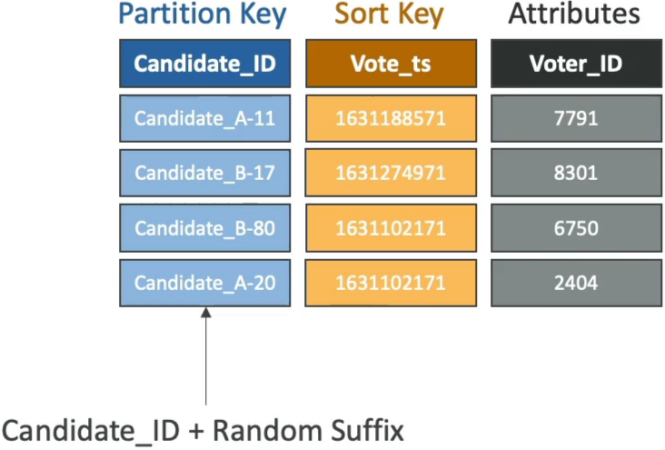
📊 The Data Transformation Mapping
Instead of writing a flat, bottlenecked key signature, look at how the data plane maps out across your partition array when you apply a sharding factor of :
| Native Logical Entity | Sharded Synthetic Partition Key (PK) | Internal Hashing Output Target | Target Partition Allocation |
|---|---|---|---|
| Candidate A | Candidate_A_1 | Hash("Candidate_A_1") | Partition Drive 1 |
| Candidate A | Candidate_A_12 | Hash("Candidate_A_12") | Partition Drive 4 |
| Candidate B | Candidate_B_7 | Hash("Candidate_B_7") | Partition Drive 2 |
| Candidate A | Candidate_A_20 | Hash("Candidate_A_20") | Partition Drive 9 |
By spreading the keys from 1 to 20, you have effectively scaled your maximum write capacity ceiling for a single candidate from straight up to , bro!
🛠️ Strategies for Generating the Suffix
Your application backend can calculate the sharding value using two core patterns, chief:
- The Random Suffix Vector 🎲: Your code fires a random integer generator bounded by your sharding factor (e.g.,
Math.floor(Math.random() * 20) + 1). This guarantees an absolutely beautiful, uniform distribution of writes across all partitions during live ingestion waves. - The Deterministic Hashing Vector 🧮: If you are sharding something like user orders, you can run a secondary attribute (like
Voter_IDorTimestamp) through a quick modulo loop (Voter_ID % 20). This makes the suffix deterministic, meaning a specific voter's records will always route to the exact same shard key variant, simplifying point lookups later!
🔍 The Catch: The Scatter-Gather Read Penalty
Write Sharding makes writes blazing fast and unthrottled, chief. But in system design, you always pay a trade-off. When it's time to read the total aggregated scores, your retrieval logic gets more complex
⛔ THE SCATTER-GATHER LAW: If your frontend dashboard needs to display the final tally for
Candidate_A, you can no longer execute a single point query targeting"Candidate_A". > Your application layer must fire off 20 parallel Query API requests in a concurrent async loop (fetchingCandidate_A_1throughCandidate_A_20simultaneously), gather the individual results back into your runtime code, and perform a client-sideSUMaggregation to compute the final score.
Exam Tips
- The Live Election / Flash Sale Scenario: If an exam prompt highlights an application that captures hundreds of thousands of transactions per second for a very small set of primary keys (e.g., a massive global poll or counting item stock on Black Friday), and states that the table keeps throwing throughput throttling exceptions despite having massive provisioned capacity headroom—look straight for Write Sharding / Synthetic Keys by appending a random suffix.
- Eliminating the Read Aggregation Overhead: If the scenario notes you want the write scaling of sharding but cannot afford the high-latency scatter-gather read loops on the frontend, look for the ultimate combo: Pipe your sharded DynamoDB Stream straight into an AWS Lambda function that maintains a single, global pre-aggregated counter row in a separate summary table.