DynamoDB Patterns with S3
Blending Amazon DynamoDB and Amazon S3 is the absolute cheat code for building elite, cost-optimized, infinitely scalable cloud architectures.
In cloud design, you never want to force a service to do something it wasn’t built for. DynamoDB is an absolute speed demon for fast, indexed, key-value lookups, but it carries a strict, unyielding 400 KB item size limit. S3, on the other hand, is a flat storage ocean that can effortlessly swallow a 5 TB object but completely sucks at granular query filtering or fast attribute lookups.
🛠️ Pattern 1: Offloading Large Items (The Pointer Pattern)
When your application handles profile avatars, deep JSON payloads, video uploads, or text-heavy PDF contracts that risk smashing past the 400 KB database ceiling, you pull this lever, chief.
Instead of stuffing raw binary or massive text blocks directly into a DynamoDB row, you split the data lifecycle:
🔄 The Write and Read Lifecycles:
-
The Mutation Ingestion Route ✍️:
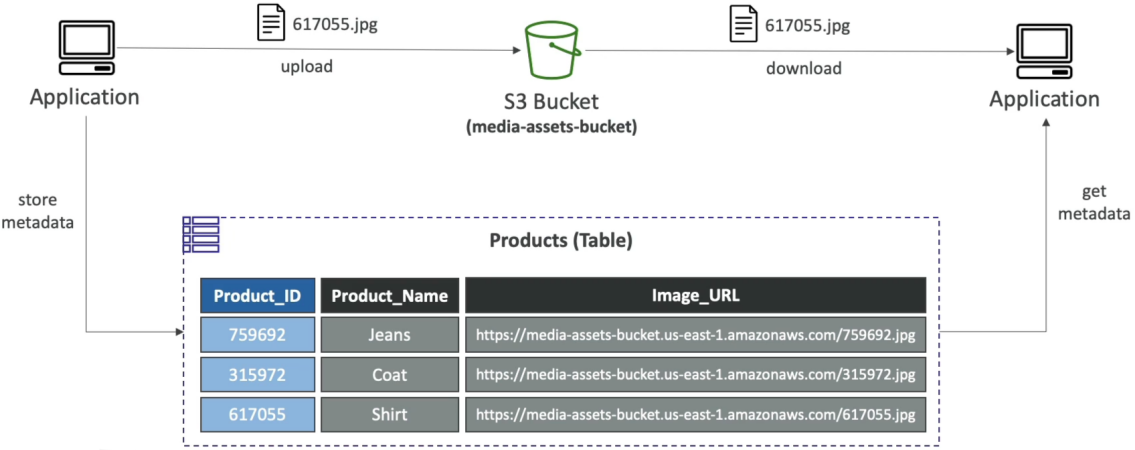
- Your application layer streams the heavy asset (e.g., an e-commerce product image) straight into a secure Amazon S3 bucket first.
- S3 writes the object and returns a unique identifier key or S3 Object URI (e.g.,
s3://my-bucket/products/prod_999.png). - The app then fires a lightweight
PutItemorUpdateItemrequest over to DynamoDB. The payload contains basic metadata fields (product_id,price,stock) along with a string attribute namedimage_urlholding that exact S3 path token!
-
The Retrieval Read Route 🔍:
- A frontend client requests the product profile. The app fires a lightning-fast
GetItempoint lookup at DynamoDB targeting theproduct_idkey. - DynamoDB returns the tiny metadata document in single-digit milliseconds.
- The application intercepts the
image_urlpointer string and uses it to generate a secure S3 Presigned URL, passing it back to the client browser to stream the heavy media asset directly from the S3 edge!
- A frontend client requests the product profile. The app fires a lightning-fast
🗀 Pattern 2: S3 Metadata Indexing (The Search Bar Pattern)
Amazon S3 is a phenomenal blob store, but it does not feature a dynamic query index. If you have a bucket containing 50 million files, and a project lead asks you to "Find every object uploaded by Client_X between 9 AM and 10 AM yesterday that is over 5 MB in size," you cannot execute that query natively on S3 without executing a high-cost, high-latency bucket list scan.
To build a high-performance search index over your static files, you invert the dependency relationship using event-driven compute:
⚡ The Real-Time Indexing Pipeline:
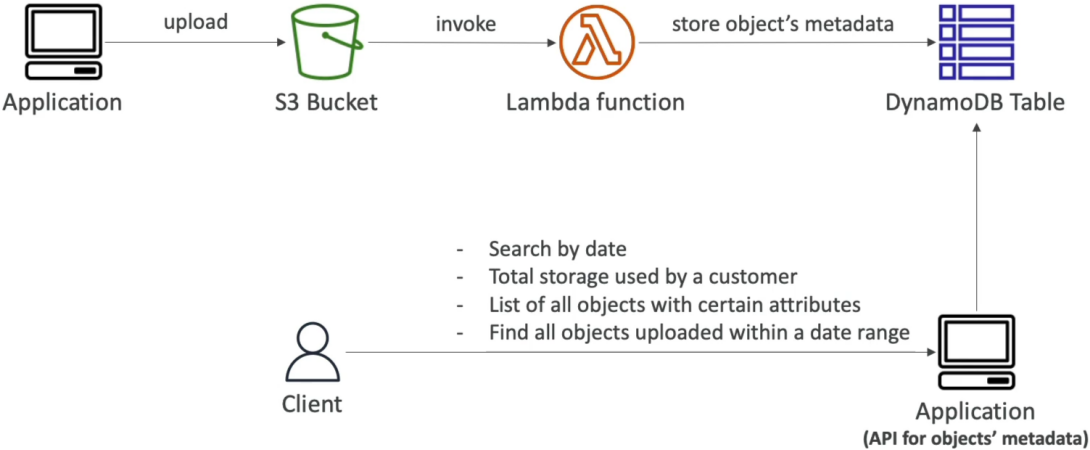
- The Object Ingestion: A microservice uploads an asset to an S3 bucket.
- The Reactive Ingest Trigger: The bucket captures the
s3:ObjectCreated:Putevent notification and instantly fires a webhook to trigger an AWS Lambda function. - The Metadata Extraction: The Lambda worker intercepts the trigger payload, inspects the file attributes (like
ContentLength,StorageClass, or custom user tags), and normalizes the attributes. - The NoSQL Commit: Lambda maps that metadata into a structured row and executes a
PutItemcall against a DynamoDB index table. The primary partition key might be theCustomer_ID, and the Sort Key could be theUpload_Timestamp!
🎯 The Payoff:
Now, when your corporate analytical dashboard needs to answer complex discovery questions, it bypasses S3 completely. Your code runs a highly optimized, single-digit millisecond Query against the DynamoDB index table, isolates the exact target file paths, and directly extracts strictly the necessary matching objects from S3, bro!
Exam Tips
- The Validation / Validation Size Trap ⚠️: If an exam prompt introduces a scenario where a legacy logging application migrating to serverless starts crashing with hard
ItemSizeExceededExceptionfaults during peak spikes—look straight for the architectural fix: Refactor the workflow to save the raw log payload body to Amazon S3, and store strictly the S3 bucket name and object key references inside the primary DynamoDB item document - Eliminating the Multi-Table Relational List Scan: If a scenario states that an operations team needs real-time, ultra-fast queries to report on internal structural characteristics of files dropping inside a massive, multi-petabyte S3 data lake (e.g., sorting by timestamp or file extensions), and warns against high execution latencies—the absolute correct answer is to build a serverless metadata index using an S3 Event Notification to trigger a Lambda function that logs the file details directly into an indexed DynamoDB table