Step Functions - Activity Tasks
When you need your state machine to offload heavy processing down to distributed background fleets—like long-running batch jobs on an EC2 cluster, embedded IoT microcontrollers, or deep-learning containers—and you want your worker nodes to actively fetch their own work rather than reacting to messages dropped in a queue, you deploy Step Functions Activity Tasks. 🏎️📡
While the goal feels very similar to the __waitForTaskToken callback layout we just crushed, the entire data ingestion philosophy flips completely on its head. We transition from a dynamic push-based messaging framework straight over to a highly organized, pull-based worker execution loop.
Key Takeaways
Let’s unpack the operational mechanisms, API orchestration loops, and the vital heartbeat check guardrails you need to know for your DVA-C02 exam.
🔄 The Pull-Based Execution Architecture
In a standard callback workflow, Step Functions actively pushes a payload out of the engine into an external landing gate (like Amazon SQS). With Activity Tasks, the pattern is entirely poll-driven.
You define a named placeholder boundary called an Activity ARN, and your worker nodes continuously query that endpoint directly for work, creating a very simple network layout since workers only need outbound connectivity to the Step Functions endpoint:
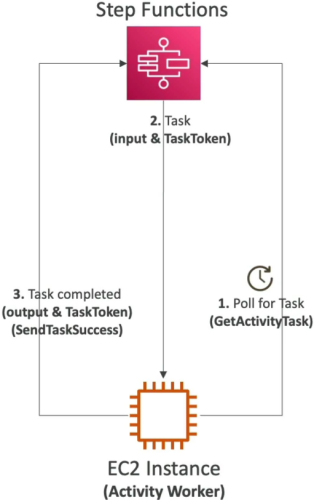
⚙️ STATE MACHINE AXIS ⚡
   └── [ Activity State: Pause & Hold ]
           ▲                 │
           │ 1. API:         │ 2. Payload Handover
           │ GetActivityTask │    & Task Token Distributed
           │                 ▼
🏗️ DISTRIBUTED WORKER FLEET (EC2 / ECS Containers / Bare Metal / IoT Devices)
   └── Process Heavy Data Loops Offline...
           │
           └── 3. API: SendTaskSuccess / SendTaskFailure ──► Resumes State Machine Line!
🎛️ The Core API Orchestration Loop
To move data across the firewall, your worker nodes continuously execute a lightweight triple-stack API sequence using the AWS SDK:
GetActivityTask🛰️: The intake pull request. Workers target the specific Activity ARN and loop this call. If a workflow execution hits that state, Step Functions halts its engine, packages the input JSON variables, generates a unique base64TaskToken, and hands the entire bundle down to the polling worker node.SendTaskHeartbeat💓: The life-support signal. While the worker is grinding away on a long compute task offline, it regularly fires this ping back to the cloud to signal: "I am still working, do not time me out!"SendTaskSuccess/SendTaskFailure🎯: The closing gate. Once the computing loops finish, the worker submits this method passing the output payload matching the exact originalTaskTokento smoothly resume the main state machine pipeline.
⏱️ Guarding Long Runs: Heartbeats vs. Timeouts
Because Activity Tasks can run on unmanaged or external infrastructure that could crash or drop network connections out of nowhere, Step Functions introduces a dual-clock safety net to ensure your pipelines never hang indefinitely:
TimeoutSeconds⏳: Sets the absolute maximum ceiling duration parameter a task is permitted to remain in an active processing loop before the system flags it as a hard failure. If you keep feeding the heartbeat loop continuously, an activity task can technically hold its state line open for up to one full year!HeartbeatSeconds💓: Dictates the maximum allowable time window between heartbeat pings before the orchestrator assumes the worker machine has dropped dead or crashed offline.
If you configure your state machine's HeartbeatSeconds variable to a value of 10 seconds, your background application logic loop should be coded to fire the SendTaskHeartbeat API call every 5 seconds. If you cut the window too close to the line, minor network jitter will cause the state machine to throw a hard States.Timeout exception, killing your execution lane prematurely!
Exam Tips
- The Push vs. Pull Network Isolation Choice: If an exam scenario presents a strict corporate firewall rule where internal security teams forbid AWS from pushing notification payloads or events directly into an on-premise datacenter network, but allows secure servers inside that datacenter to make standard outbound HTTPS calls to the public internet—bypass the SQS
waitForTaskTokencallback strategy entirely! Choose the answer that implements Step Functions Activity Tasks, enabling the on-premise servers to cleanly poll out using theGetActivityTaskAPI loop. - The Unmanaged Worker Drop Recovery: If a prompt describes a cluster of spot-instance EC2 workers processing intensive media rendering tasks pulled from Step Functions, and asks how to ensure that if a spot instance is suddenly terminated mid-job, the state machine instantly detects the crash and routes a cleanup task—look straight for setting a tight
HeartbeatSecondsparameter on the Activity state, allowing the engine to catch the missing ping and trigger aCatchfallback route immediately.