Step Functions - Error Handling
If you are writing complex nested try/catch loops inside a Lambda function, setting manual execution timeouts, and managing your own tracking database records just to handle a temporary network drop, you are burning valuable code velocity. If a transient network glitch happens or an downstream database chokes, the Lambda function should crash hard on purpose. You let the orchestrator—AWS Step Functions—intercept the crash, manage the retry logic metrics, and route fallback pathing loops completely out-of-band.
Key Takeaways
🛠️ The Core Cloud Error Codes Grid
When a Task, Map, or Parallel state blows up at runtime, Step Functions matches the failure behavior against these native, predefined core exception strings:
States.ALL🃏: The ultimate global catch-all wildcard descriptor. Matches any known runtime error type signature.States.Timeout⏳: Thrown the absolute microsecond a task execution surpasses the explicitTimeoutSecondsmetric limit or drops its background activityHeartbeatSecondsmonitoring clock.States.TaskFailed📉: Caught when the target computing unit completely chokes at runtime—like a Python or Node.js Lambda function throwing an unhandled code exception array or running entirely out of runtime memory.States.Permissions🔑: Dropped when the state machine's underlying IAM execution role lacks sufficient privilege scopes to successfully invoke the downstream target resource asset.
🔄 The Micro-Engineered Retrier Matrix (Retry)
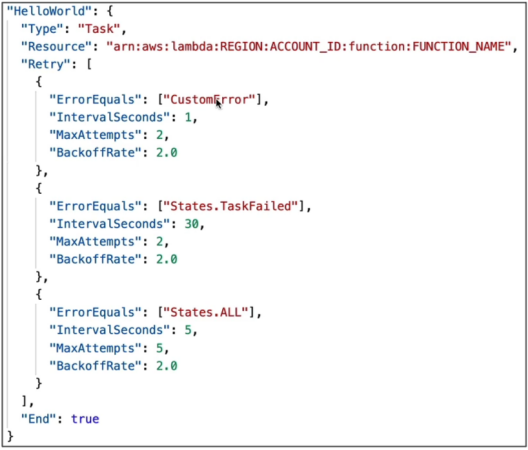
The Retry block array tells the orchestration system how to automatically salvage a transient runtime failure. Rules evaluate in a strict top-to-bottom hierarchy. Check out this highly resilient ASL payload breakdown:
🎛️ The Math Mechanics Behind the Rate:
Let's trace that second retrier targeting a basic States.TaskFailed container crash:
- Attempt 1: Wait exactly (
IntervalSeconds) before retrying. - Attempt 2: Multiply the previous delay duration parameter by the
BackoffRate(). - If that final attempt fails, the retrier drops the session out because it hit its maximum threshold boundary (
MaxAttempts: 2), forcing the flow instantly down into the activeCatchinfrastructure loop!
🎯 The Graceful Rescue Engine (Catch)
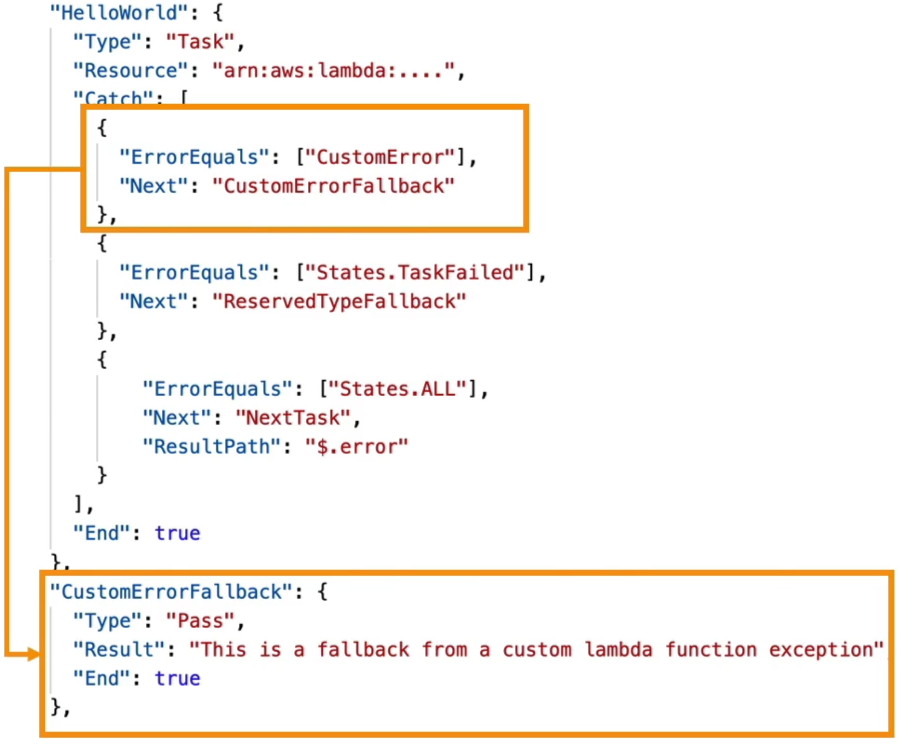
When retries are completely spent or an error matches a terminal code signature, you activate a Catch block array to steer the traffic payload cleanly into a fallback route state:
🔀 The High-Stakes Target Filter: ResultPath
This is a high-frequency milestone concept on the blueprint. Pay close attention to how it handles JSON data injection paths:
- The Default Behavior Trap 🚨: If you do not explicitly declare a
ResultPathin your catcher parameters, the returning error stack information object will completely nuke and overwrite the state machine's initial input payload data block. - The Preservation Play 📥: By configuring
"ResultPath": "$.errorInfo", the state machine smoothly intercepts the inbound data dictionary (like{"foo": "bar"}), injects the error logs cleanly under a fresh, nested sub-key tracker, and passes the combined tracking map down to the fallback node path:
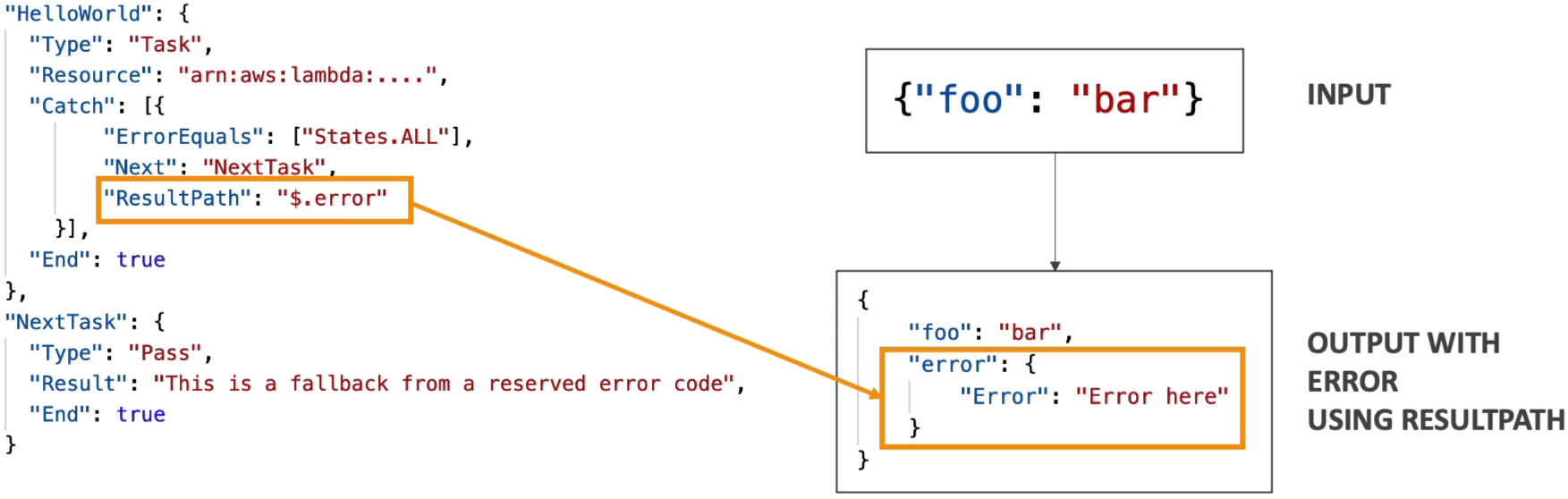
This allows your downstream emergency handler steps (like an SMS alert manager or a Slack webhook publisher) to see exactly why the pipeline crashed while retaining complete context of the user payload variables that triggered the event.
Exam Tips
- The MONSTROUS Lambda Bill Reducer: If an exam prompt sets up a scenario where an engineering squad wants to optimize serverless operating budgets by ensuring an integration task retries transient network connection locks safely over a 10-minute window, but demands a solution that keeps individual compute execution times locked down to single-digit seconds—choose the answer that strip out internal
while/retrycode blocks from the Lambda function entirely and leverages a Step FunctionsRetryblock configured with an exponentialBackoffRateand customIntervalSecondsparameters. - The Input Preservation Target: If a question introduces a distributed task failure path where the fallback node keeps crashing because the user context data is completely missing by the time it lands inside the error tracking step—look straight for fixing or adding an explicit
ResultPathfilter format (like$.error) on the Catcher parameter declaration list to prevent the raw error dictionary from overwriting the master state stream.