CloudHSM Overview
AWS CloudHSM is the ultimate heavy-artillery cryptographic solution when fully managed KMS services just don't give your enterprise compliance auditors the exclusive hardware control they demand. 🏎️🛡️
While KMS abstracts away the underlying Hardware Security Modules (HSMs) in a multi-tenant, zero-maintenance model, CloudHSM drops dedicated, single-tenant, physical HSM hardware straight inside your own VPC.
Key Takeaways
🏗️ Architecture & Security Model
With CloudHSM, AWS manages the physical hardware rack, cooling, and firmware updates, but you hold 100% ownership over the cryptographic keys, user permissions, and access controls. AWS operators have zero access to your keys or plaintext data!
🌎 YOUR VIRTUAL PRIVATE CLOUD (VPC)
   └── 🔐 CloudHSM Cluster (Single-Tenant Hardware)
           ├── 🏢 Subnet AZ-1: HSM Device #1  ◄──┐
           │                                      ├── Managed High-Availability Sync
           └── 🏢 Subnet AZ-2: HSM Device #2  ◄──┘
                    ▲
                    │ 🛰️ Direct Connection via CloudHSM Client Software (PKCS#11, JCE, CNG)
                    │
   💻 EC2 Application Nodes / On-Premise Servers
- Physical Isolation & Compliance: Hardware devices are single-tenant and certified to FIPS 140-2 Level 3 / FIPS 140-3 Level 3. If anyone attempts physical tampering or environmental attacks on the rack, the hardware actively erases key material instantly!
- Crypto Primitives Supported: Supports Symmetric (AES), Asymmetric (RSA/ECC), Hashing algorithms, and SSL/TLS web server offloading!
- High Availability (HA): Provision HSM instances across multiple Availability Zones inside a single cluster. The CloudHSM client software automatically handles load-balancing and synchronization between devices.
🌉 KMS Custom Key Store (The Hybrid Bridge)
How do you get the compliance power of a dedicated HSM while retaining the simple API developer experience of AWS services like S3, EBS, and RDS? You connect CloudHSM to KMS as a Custom Key Store.
📦 Amazon S3 / EBS / RDS ──► 🔑 AWS KMS APIs ──► 🔐 Custom Key Store ──► 🛡️ CloudHSM Cluster
                                                                           (Keys generated & stored inside dedicated HSM)
- How it works: KMS uses your CloudHSM cluster as its underlying storage engine. Whenever an AWS service requires an encryption key, KMS routes the generation/decryption call straight to your dedicated CloudHSM cluster.
- Audit Trail: Every operation triggers an audit record in AWS CloudTrail, giving you end-to-end visibility across all key usages.
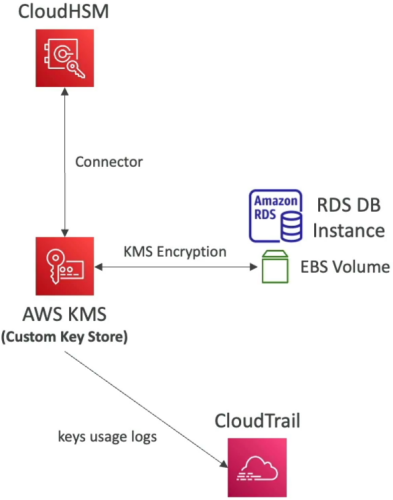
📊 AWS KMS vs. AWS CloudHSM
This side-by-side matrix locks down the primary architectural differences for exam scenarios:
| Feature Dimension | 🔑 AWS KMS | 🛡️ AWS CloudHSM |
|---|---|---|
| Tenancy Model | Fully Managed, Multi-Tenant | Single-Tenant Dedicated Hardware |
| Access Control | AWS IAM Policies & KMS Key Policies | CloudHSM Client Software (Users/Roles defined inside HSM) |
| Network Location | Public Regional AWS API Endpoint | Deployed inside your private VPC |
| AWS Service Integration | Native integration with 100+ services | Custom integration OR via KMS Custom Key Store |
| Key Exportability | Cannot export CMK plaintext key material | Keys CAN be exported / wrapped for migration |
| Pricing Model | Pay per key / per request (0.03/10k requests) | Hourly rate per provisioned HSM (~$1,000+/mo, NO Free Tier!) |
Exam Tips
- The Strict Single-Tenant Hardware Requirement 🚨: If a scenario specifies that contractual or regulatory mandates (e.g., PCI-DSS or corporate audit requirements) demand dedicated, single-tenant hardware where AWS employees have zero access to keys under any circumstances—bypass standard KMS immediately! Choose AWS CloudHSM.
- The IAM vs. Native HSM User Fallacy: If a question asks why an IAM administrator cannot create or modify crypto users or generate keys inside a CloudHSM cluster—remind yourself that IAM only manages the cluster's lifecycle (creation/deletion)! Key generation and user access are strictly managed via the CloudHSM Client software tools.
- Server-Side Encryption with Customer-Provided Keys (SSE-C): If an application stores objects in Amazon S3 using SSE-C where you must manage your own encryption keys in a secure, tamper-resistant environment—CloudHSM is the top candidate for storing and generating those external keys!