AWS AppConfig - Overview
AWS AppConfig (a capability of AWS Systems Manager) is the ultimate operational power play for decoupling your application code deployments from dynamic runtime configurations! ⚡
Instead of baking environment settings directly into build artifacts or forcing full container or EC2 restarts just to toggle a feature, AppConfig lets you update configuration data and feature flags dynamically at runtime in real time.
Key Takeaways
Let's go over the core concepts, deployment rollout strategies, validation checks, and the essential DVA-C02 tips for your exam survival guide.
🏗️ Core Concepts & Architectural Components
                               ┌────────────────────────────────────────────────────────┐
                               │                     AWS APPCONFIG                      │
                               └───────────────────────────┬────────────────────────────┘
                                                           │
             ┌─────────────────────────────────────────────┼─────────────────────────────────────────────┐
             ▼                                             ▼                                             ▼
📄 Configuration Profiles                      🧪 Application Environments                    🚀 Deployment Strategies
  • Feature Flags (`AWS.AppConfig.FeatureFlags`) • Dev, Staging, Production                     • Linear / Exponential Rollouts
  • Freeform (`JSON`, `YAML`, `Text`)            • Tracks active configurations                 • Bake Times (Monitoring window)
  • Hosted Store, SSM Parameter, S3, SSM Doc     • Tied to CloudWatch Alarms                    • Instant Automatic Rollbacks
-
Applications & Environments:
- Application: The top-level logical container representing your microservice.
- Environment: Logical deployment targets (e.g.,
Dev,Staging,Prod).
-
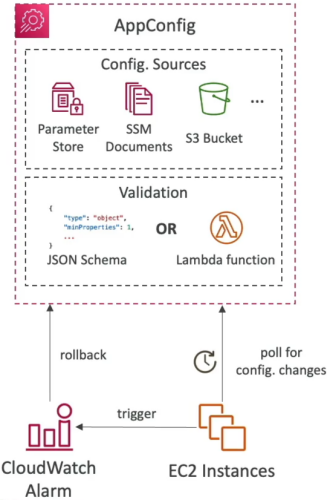
Configuration Profiles & Storage Sources: Defines where your configuration data lives:
- AppConfig Hosted Store: Built-in, fully managed configuration store (ideal for Feature Flags).
- SSM Parameter Store: References plaintext parameters or
SecureStringconfigurations. - Amazon S3 Buckets / SSM Documents: References raw configuration files stored in S3 or Systems Manager documents.
-
Feature Flags: Allows you to deploy new code behind conditional toggles (
true/falseor complex JSON rules). Features can stay inactive in production until you flip the flag at runtime without redeploying code.
🛡️ Validation & Safe Rollout Mechanics
Deploying a bad configuration value (e.g., a broken JSON key, a string instead of a boolean, or an out-of-range port number) can take down a fleet faster than a code bug. AppConfig enforces safety using two distinct layers:
Layer 1: Configuration Validation (Before Deployment)
AppConfig runs validation checks at upload time before any deployment can start:
- JSON Schema Validator: Checks structural/syntax correctness (e.g., verifying types like booleans or numbers, minimum/maximum constraints).
- Lambda Function Validator: Executes custom code logic for semantic validation (e.g., attempting a test database connection or verifying that an external endpoint is reachable).
Layer 2: Gradual Deployment & CloudWatch Alarm Rollback (During Deployment)
When you deploy a new configuration version, AppConfig uses a Deployment Strategy:
 🚀 Deployment Starts ──► 📈 Gradual Rollout (e.g., 10% ➔ 50% ➔ 100%)
                                 │
                                 ├── (CloudWatch Alarm Fires!) ──► 🚨 AUTOMATIC INSTANT ROLLBACK!
                                 │                                 (Reverts fleet to last known good state)
                                 ▼
                         ✅ Bake Time Period Passes ──► Deployment Complete
- Step Percentage & Growth Type: Controls what percentage of application instances receive the updated configuration over time (Linear or Exponential).
- Bake Time: A designated monitoring period after the configuration is fully distributed to ensure system stability.
- Automatic Rollback: AppConfig continuously monitors attached Amazon CloudWatch Alarms. If an operational metric breaches thresholds during deployment or bake time, AppConfig automatically halts the rollout and reverts all clients to the last known good configuration state!
💻 Application Fetch Pattern & AppConfig Agent
Client applications running on EC2, ECS, EKS, or AWS Lambda poll for configuration changes:
- AWS AppConfig Helper / AppConfig Agent: A lightweight sidecar or Lambda extension that automatically handles client-side caching, fetching update tokens, and polling AppConfig APIs (
GetLatestConfiguration) efficiently in the background.
⚔️ AppConfig vs. SSM Parameter Store vs. Secrets Manager
| Feature Matrix | 🎛️ AWS AppConfig | 🗄️ SSM Parameter Store | 🔐 AWS Secrets Manager |
|---|---|---|---|
| Primary Use Case | Dynamic runtime configs, feature flags, operational toggles | Static app parameters, URLs, configuration values | Encrypted credentials, API keys, DB passwords |
| Gradual Deployment | Native (Linear/Exponential percentage rollouts) | None (Instant global update) | None (Instant global update) |
| Validation Checks | Native (JSON Schema & Lambda Function validators) | Basic type checking (String, SecureString) | Basic syntax |
| Auto-Rollback | Native via CloudWatch Alarms | None | None |
Exam Tips
- The Feature Flag Rollout Scenario 🚨: If a scenario asks for a service to toggle new application features in real time or safely release features to user subsets without redeploying application code or restarting instances—always select AWS AppConfig.
- Preventing Bad Configuration Outages: If an exam question asks how to ensure a dynamic configuration file does not contain invalid port numbers or broken schemas prior to being released across an EC2 fleet—choose AWS AppConfig with JSON Schema or AWS Lambda Validators!
- CloudWatch Alarm Integration: If a scenario requires deploying configuration changes gradually while automatically reverting back if application error rates spike—select configuring an AWS AppConfig Deployment Strategy bound to CloudWatch Alarms!