ElastiCache Strategies
Caching strategies dictate the exact sequencing your application code uses to manage traffic flows between an in-memory database (ElastiCache) and a persistent disk database (RDS). Lazy Loading is a reactive pattern that only saves data when an user explicitly reads it, creating an ultra-lean cache footprint but risking stale data. Write-Through is a proactive design that forces the application to mirror database changes inside RAM instantly upon every write operation, eliminating data staleness at the cost of slower save cycle.
Key Takeaways
🏎️ Lazy Loading (Cache-Aside/Lazy Population)
This is a reactive read-optimization pattern. The application treats the database as the master of truth and only populates the cache on a complete cache miss.
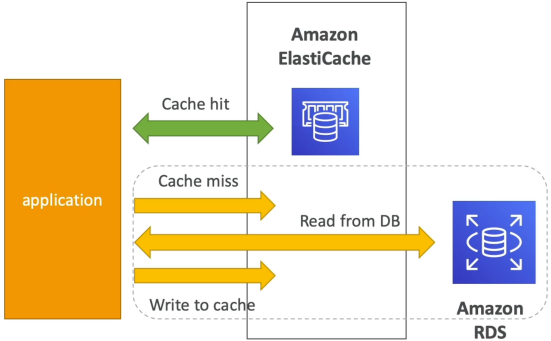
Operational Blueprint Flow:
- Application initiates a data read request. It checks ElastiCache first.
- The Cache Hit (best case): Data is present in RAM. It instantly returns the data to the client with sub-millisecond latency. One network call.
- The Cache Mis (worse case): Data is missing. The application triggers three consecutive network hops:
- Hop 1: Ask Cache > get back (
none) - Hop 2: Ask RDS > Run SQL Query to fetch the live row
- Hop 3: Run a
setcommand to store that row in ElastiCache so the next reader hits the fast path
- Hop 1: Ask Cache > get back (
The Pseudocode logic pattern
def get_user(user_id):
    # Step 1: Check the caching ring first
    record = cache.get(user_id)

    # Step 2: The Cache Miss Logic Gate
    if record is None:
        record = db.query("SELECT * FROM users WHERE id = ?", user_id) # Fetch true state
        cache.set(user_id, record)                                     # Populate for next time

    return record
The exam expects you to look at a code snippet and immediately identify the pattern. Notice how the database layer is only invoked inside the if record is None block.
- The Pros: Highly cost-effective. Your cache only allocates memory for keys that users are actually reading. A complete node failure isn't fatal, it just requires a temporary latency spike while the cache "warms up" again.
- The Cons: Data can easily become state if a separate background process modifies RDS without updating ElastiCache.
🛡️ Write-Through
This is a proactive write-optimization pattern. Instead of waiting for a reader to encounter a slow cache miss, the system updates the memory tier immediately when data changes.
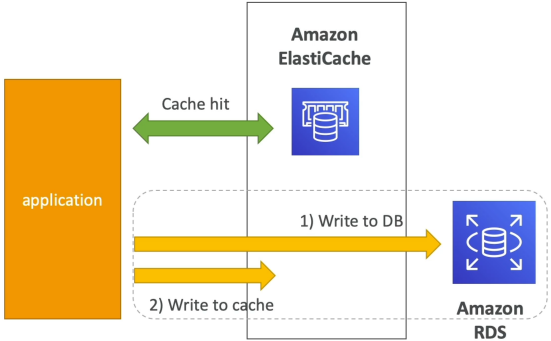
Operational Blueprint Flow:
- Application receives an insert or modify request (
POST,PUT,DELETE). - The Database Commit: The application executes a query directly against RDS.
- The Cache Mirror: Immediately following a successful database commit, the code fires an atomic write up to ElastiCache, swapping or creating the identical key inside RAM.
The Pseudocode Logic Pattern
def save_user(user_id, values):
    # Step 1: Write the updated truth to the permanent disk tier
    record = db.query("UPDATE users SET values = ? WHERE id = ?", values, user_id)

    # Step 2: Immediately force the cache to match the disk state
    cache.set(user_id, record)

    return record
Notice how this logic explicitly targets mutating data operations (save_user) rather than lookup actions (get_user).
- The Pros: Data in cache is never stale. Read operations are guaranteed to be blazing fast and completely avoid the triple-roundtrip cache-miss penalty. It also shifts deployment overhead to the write phase, where users naturally expect a tiny processing delay.
- The Cons: Infrequently requested data is permanently pushed into RAM, risking high Cache Churn and filling up expensive memory slots with zombie keys that are never read.
Eviction, Thrashing, and the TTL Guardrail
Because RAM is expensive, highly limited resource compared to massive multi-terabyte database disks, you must manage your cache size using two distinct safety valves:
- Cache Evictions (LRU): When ElastiCache hits 100% memory capacity, the database engine executes a Least Recently Used (LRU) eviction policy. It automatically drops the oldest, cold keys from memory to open slots for incoming data. If your cloud monitoring dashboards indicate a massive spike in Evictions, it means your cache is too small (Cache Thrashing) and you must scale your instance sizes up or add shards.
- Time-To-Live (TTL): An explicit integer flag representing the lifespan of a cached key in seconds. Setting a conservative TTL (e.g., 300 seconds) acts as a beautiful hybrid guardrail. It guarantees that even if you use the Lazy Loading strategy, stale-data will self-destruct within 5 minutes, forcing clean, up-to-date database on the next request.
Exam Tips
The "Zombie Storage" Optimization": If an exam questions says, "You deployed a Write-Through caching layer over an RDS database that handles billions of transactional rows. Over time, your ElastiCache costs spike significantly, and logs show that 90% of the data mirrored into RAM is never read by consumer before getting evicted.", you are dealing with bad cache design. The best practice solution is to refactor your code to utilized Lazy Loading as your foundation tier, and only implement Write-Through on highly targeted, specific keys that experience intense, repeated read traffic (like user session tokens or site setting array).
Practice Test
Question: The development team at an e-commerce company is preparing for the upcoming Thanksgiving sale. The product manager wants the development team to implement appropriate caching strategy on Amazon ElastiCache to withstand traffic spikes on the website during the sale. A key requirement is to facilitate consistent updates to the product prices and product description, so that the cache never goes out of sync with the backend.
As a Developer Associate, which of the following solutions would you recommend for the given use-case?
- Use a caching strategy to write to the backend first and then invalidate the cache
- Use a caching strategy to write to the cache directly and sync the backend at a later time
- Use a caching strategy to update the cache and the backend at the same time
- Use a caching strategy to write to the backend first and wait for the cache to expire via TTL
Correct Answer
- Use a caching strategy to write to the backend first and then invalidate the cache
- Explanation: Writing to the database first and immediately invalidating (or updating) the cache key ensures that stale data is evicted. Upon the next read request, the application experiences a cache miss, fetches the fresh price/description from the database, and repopulates the cache. This pattern guarantees strong consistency while avoiding stale reads during high-traffic events.
- Use a caching strategy to write to the cache directly and sync the backend at a later time
- Explanation: This write-behind/write-back approach risks data loss if the cache node fails before syncing to the database, making it unsafe for critical product pricing and transaction data.
- Use a caching strategy to update the cache and the backend at the same time
- Explanation: The cache layer and database are separate distributed systems that cannot be updated simultaneously via a single atomic operation without distributed locking, which introduces extreme latency and potential failure modes.
- Use a caching strategy to write to the backend first and wait for the cache to expire via TTL
- Explanation: Relying solely on TTL expiration leaves a window of time where the cache serves outdated product prices or descriptions until the TTL elapses, violating the strict requirement to keep data synchronized.