Route 53 Health Checks
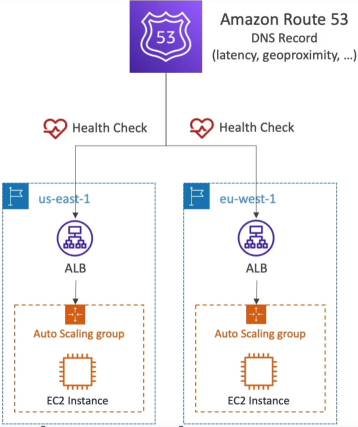
Global multi-region is completely useless if a data center drops offline and your DNS keeps blindly sending users to the dead IP address. Route 53 Health Checks are the exact architectural glue that turns static DNS maps into an automated, self-healing global traffic grid.
Route 53 Health Checks provide active, real-time monitoring of your application endpoints to orchestrate Automated DNS Failover. By constantly validating resource availability, Route 53 dynamically rewrites its active zone respones, stripping out dead or failing server arrays and ensuring user traffic is strictly routed to surviving infrastructure nodes.
Key Takeaways
Deep Dive: The 3 Health Check Types
AWS splits its health monitoring mechanics into three distinct design patterns based on where your resource lives and how you want to evaluate its performance:
🌐 Type 1: Endpoint Monitoring (Public-Facing Resources)
This is the default proactive probing mechanism. A distributed array of roughly 15 global AWS health checkers located all over the planet continuously throw automated network requests at your public endpoint.
- The Healthy Threshold Matrix: To pass, your endpoint must respond with a standard HTTP
2xxor3xxstatus code within the configured time constraint. - String Matching Superpower: For deep application layer checks, you can configure String Matching. Route 53 will scrape and read the first 5,120 bytes of your server's HTML/text response body looking for an explicit confirmation keyword (like
HEALTHYorstatus_ok). - The Frequency Profiles:
- Standard: Runs probes every 30 seconds (Default, cost-effective)
- Fast Check: Runs probes every 10 seconds (Higher billing surcharge, but drops your failover detection window dramatically)
- The Global Consensus Rule: Route 53 aggregates the results of all 15 global probing nodes. If more than 18% of the global checkers report that the server is alive, Route 53 keeps the endpoint marked as healthy. If accessible drop to 18% or lower, it trigger a system failover event.
- Firewall Perimeter Rule: For this to work, your SGs and Network ACLs must explicitly allow inbound traffic from the official Route 53 Health Checks IP range. If you block them, the checkers will register a timeout and pull your healthy server offline by accident.
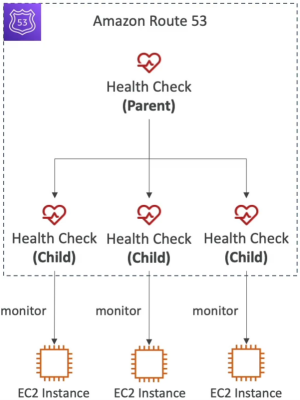
🔮 Type 2: Calculated Health Checks (The Logic Evaluator)
Calculated health checks do not ping any servers directly. Instead, they act as a parent container that watches the other "child" health checks and combines them using standard boolean operators (AND, OR, NOT).
- The Scale Capacity: A single parent can monitor up to 256 distinct child health checks.
- The Production Playbook: You can configure a rule stating: "This parent check is healthy as long as at least 2 out of our 3 redundant backend EC2 instances are responding." This allows your operation team to gracefully take an individual server offline for maintenance without triggering a global catastrophic DNS failover alarm.
🛡️ Type 3: CloudWatch Alarm Monitoring (The Private VPC / On-Premises Shield)
Because Route 53's external health checkers live on the public internet, they are physically blocked from reaching private resources sitting inside locked-down private subnets (`10.0.x.x) or on-premises corporate infrastructure over a VPN.
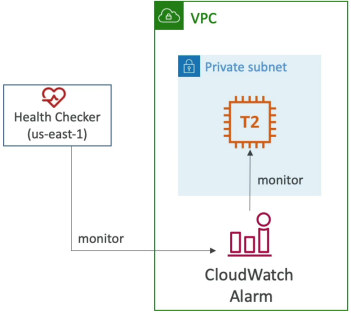
To bridge this air-gap, you utilize a reactive metrics loop:
- You configure internal resource tracking (like an EC2 instance's CPU Utilization, memory exhaustion, or private RDS query latencies).
- You map a CloudWatch Alarm to that specific metric.
- You link Route 53 straight to that alarm status. If the alarm trips into the
ALARMstate, Route 53 flags the associated health check as unhealthy on the spot, routing public traffic away from the impacted private stack seamlessly.
Exam Tips
The Calculated Failover Equation: The exam will expect you to calculate how long it takes for a system to complete a cross-region failover. The total time required is governed by a strict equation:
Total Failover Time = Record TTL + (Check Interval × Failure Threshold)
If a scenario states, "Your records has a TTL of 60 seconds, your health check runs on a fast 10-second interval, and your Failure Threshold is set to 3 consecutive failures", the math works out to
Total Failover Time = 60 + (10 × 3) = 90 seconds