Routing Policy: Multi Value
The Multi Value Routing Policy is essentially Simple Routing on Steroids, the biggest takeaway here is the integration of Health Checks. While a multi-value Simple record blindly throws a list of IPs at a client (even if half of them are dead), Multi-Value answer routing acts like an intelligent safety net.
When a client queries the domain, Route 53 evaluates the health of all nodes on the fly and returns a randomized subset of up to eight strictly healthy records. This delivers native, client-side round-robin load balancing without the cost of a physical load balancer.
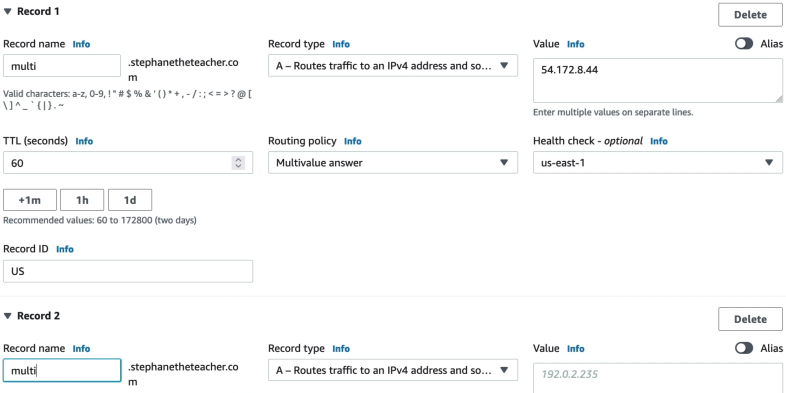
Key Takeaways
The Multi-Value Resolution Mechanic
🟢 The All-Healthy Baseline State
When you run dig multi.example.com while all your regional instances (Singapore, Sydney, Frankfurt) are healthy, Route 53 packages all three distinct IP answers into the Answer Section of a single DNS response payload. The client's operating system handles the choice from there.
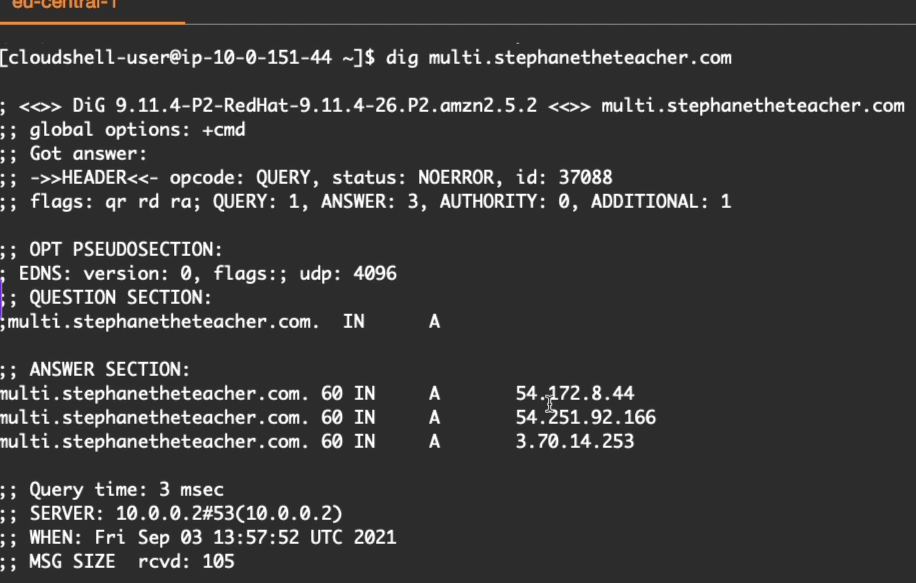
🔴 The "Inverted" Failure State
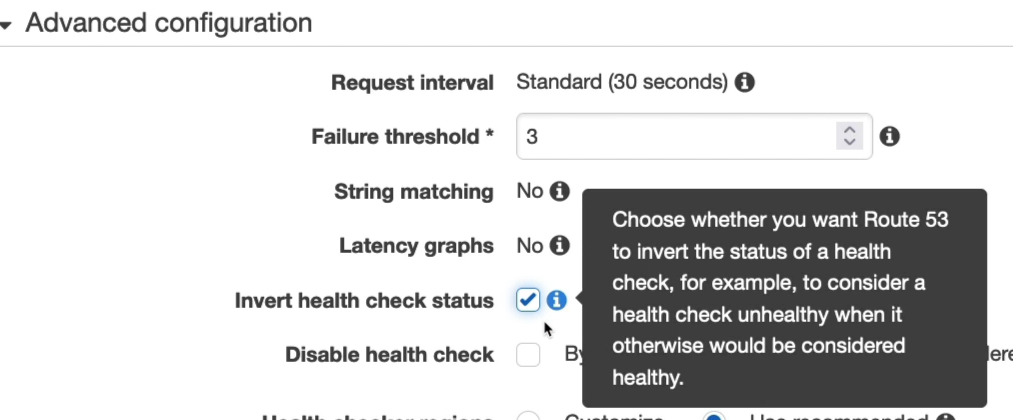
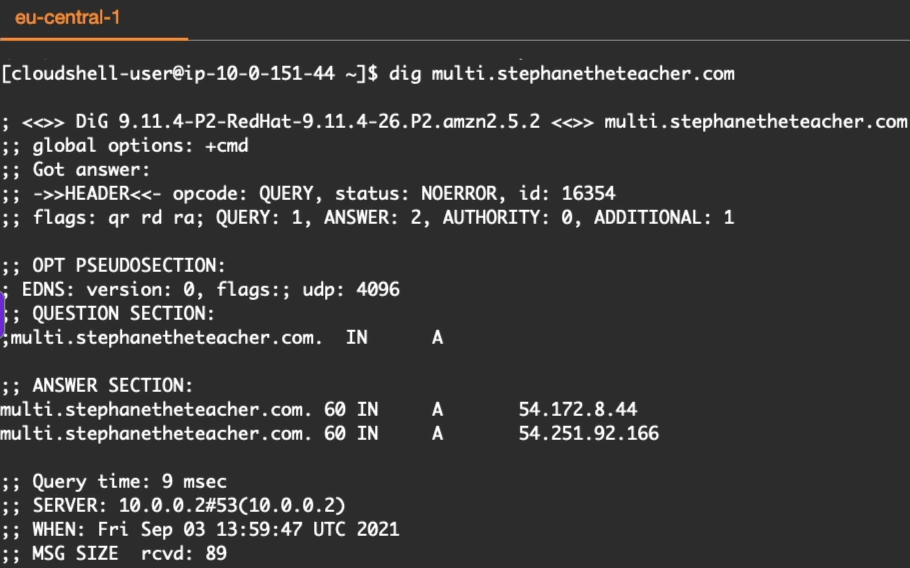
When Stephane checks the "Inverted Health Status" box on the Frankfurt (eu-central-1) health check, he tells AWS: "Treat a running server as dead". The exact second route 53 registers this state shift, it alters its DNS response. The next time you fire a dig command, the Frankfurt IP disappears from the payload, leaving only the surviving N. Virginia and Singapore addresses. The client never even learn the dead IP existed, preventing a browser connection timeout.
⚖️ Simple vs. Multi-Value vs. ELB
| Architectural Metric | Simple Routing (Multi-IP list) | Multi-Value Answer Routing | Elastic Load Balancer (ALB/NLB) |
|---|---|---|---|
| Record Sizing Matrix | One single record containing a flat list of multiple IP addresses. | Multiple separate records sharing the same name and a unique Record ID. | A single record pointing straight to a scalable proxy array. |
| Active Health Checking | ❌ Completely Unsupported. Blindly serves dead targets. | ✅ Fully Supported. Drops unhealthy records instantly. | ✅ Fully Supported at the protocol layer. |
| Maximum Return Count | Returns all hardcoded values in the record container. | Returns up to 8 healthy records at random per query request. | Returns the target proxy IP mapping layer. |
| Alias Target Support | Yes. | ❌ No. Standard A or AAAA IP addresses only. | Yes (Native integration). |
| Load Balancing Type | "Primitive, client-side round-robin." | Client-side round-robin up to 8 targets. | True server-side load balancing with sticky sessions and connection draining. |
Not an ELB Substitute: If you have 50 healthy servers mapped under a multi-value setup, Route 53 will randomly select 8 of them to return to a user. If that user's browser grabs the list, it connects to one IP. If that specific machine gets overwhelmed with heavy traffic, DNS cannot save you. A real Load Balancer (ELB) acts a physical middleman that measures actual traffic concurrency and routes packets intelligently - DNS just hands out a list of options.
Exam Tips
The Multi-Value Sizing Limit: Pay close attention to the data constraint. If an exam scenario says, "You have configured a Multi-Value Answer routing policy for a microservice endpoint that spans across 12 independent, single-instance EC2 nodes globally. If 3 of these nodes crash simultaneously, how many IP addresses will Route 53 return to a client executing a fresh DNS lookup?", Let's do the math: You started with 12 records, 3 crashed, leaving 9 healthy nodes. Because the Multi-Value specification carries a strict maximum cap of 8 records per response, Route 53 will randomly grab 8 out of those 9 healthy IPs and stream them to the consumer, discarding the 9th healthy one from that specific query frame.