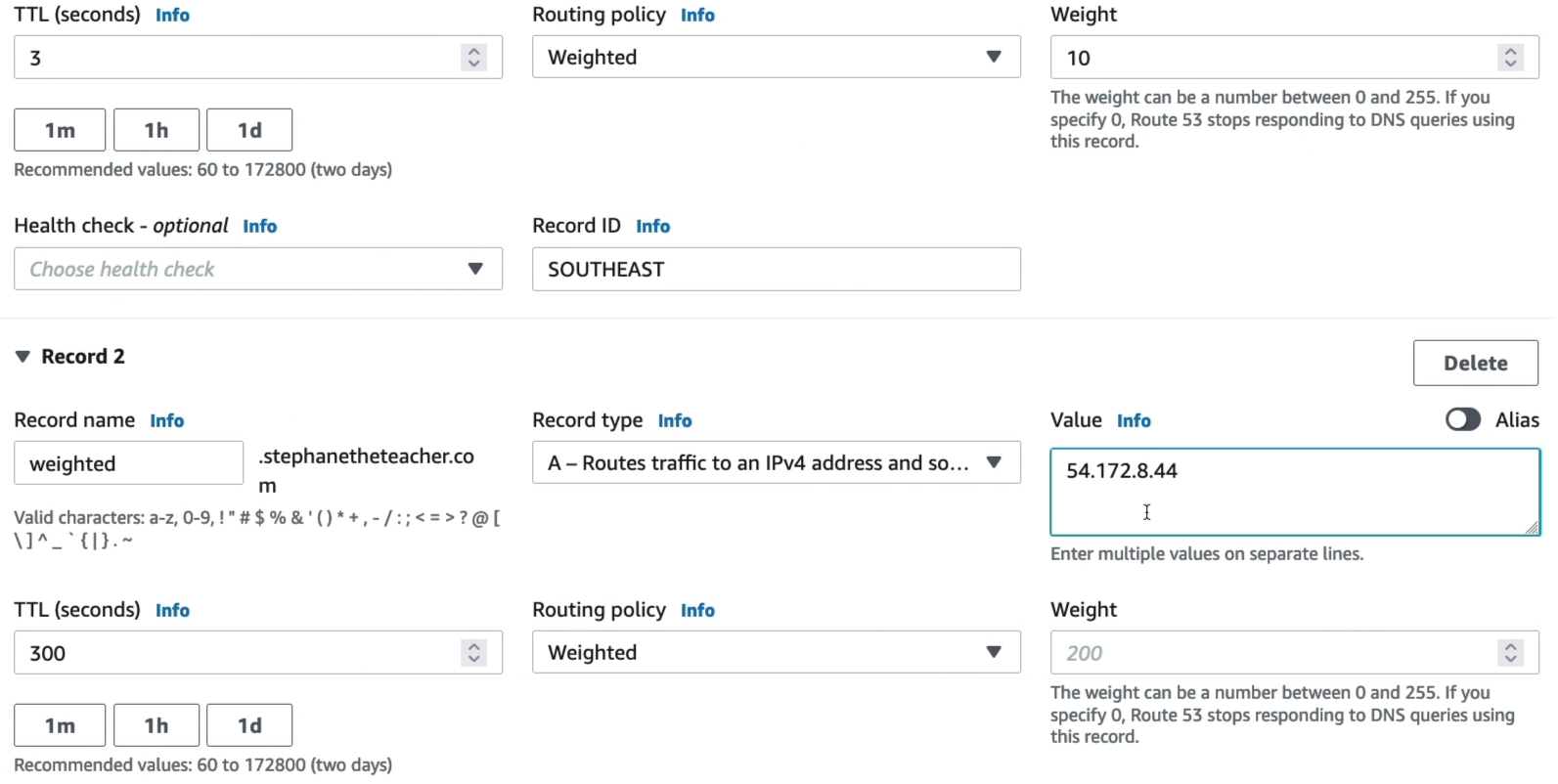
Routing Policy: Weighted
Unlike the simple policythat just blindly shuffles a bunch of IPs, weighted routing lets you precisely dial in exactly what percentage of global DNS queries get answered with which specific infrastructure backend.
The Weighted Routing Policy allows the engineers to create multiple independent DNS records of the identical name and type, assigning each record a relative numerical weight (from 0 to 255). When a client queries Route 53, the service dynamically calculates a probability matrix on the fly. The chance of specific record being returned is its identical weight divided by the sum total of all active weights in that record set.
Key Takeaways
The Math
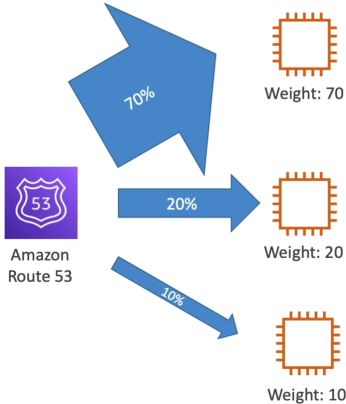
Let's say you configure three EC2 instances behind a single DNS name, each with the following weights:
- AP-Southeast (Singapore): Weight 10
- EU-Central (Frankfurt): Weight 20
- US-East (Virginia): Weight 70
- Total Weight: 10 + 20 + 70 = 100
Traffic to US-East = 70/100 = 70%
The weights do not have to add up to 100. If you create two records and give one a weight of 1 and the other a weight of 1, the sum is 2. Each record will receive exactly 50% (1/2) of the traffic. Route 53 just evaluates the relative ratios between the numbers.
The Power of Weigh = 0
Setting a record's weight to exactly 0 triggers an explicit architectural guardrail:
- The Traffic Kill-Switch: Route 53 will completely stop returning that specific IP address or resourceendpoint to consumers. This is perfect for cleanly draining traffic off a legacy server pool during updates without deleting the underlying record configuration.
- The "All Zero" Paradox": If you configure every single record in a weighted set to weight of 0, Route 53 drops the math entirely and treats them as equally weighted, returning them randomly with equal probability across the board.
Prime Production Use Cases
- 🏎️ Canary Deployment/Version Testing: When launching a brand-new, unproven version of your app (Version 2), you don't want to risk crashing your whole user base. You deploy Version 2 on a fresh server tier, add it to your weighted record set, and give it a tiny weight of 5 while keeping Version 1 at a weight of 95. You monitor your error budgets, log streams, and performance metrics. If it holds up, you gradually scale the Version 2 weight up to 100 and drop Version 1 down to 0.
- ⚖️ Cross-Region Load Balancing: Coarsely dividing traffic loads between major geographic infrastructure clusters if you aren't using advanced automation proxies.
Exam Tips
The Hosted Zone Layout Distinctness: Pay close attention to how this looks in the console versus as Simple record block. In a Simple record, you have one single record line item that holds a big text array of multiple internal IPs. In a Weighted Routing Policy, you must explicitly create multiple, completely separate record entries in your Hosted Zone list. Each individual row has its own unique Record ID descriptor (like US-East or EU-Central), its own specific weight value, and maps to exactly one unique destination value.